
During his first presidential campaign nearly 10 years ago, Donald Trump promised to “load” up the infamous prison at Guantánamo Bay with “some bad dudes.”
Weeks after Trump’s second inauguration, the administration put 10 migrants on a flight to Guantánamo, claiming without evidence that they were members of a Venezuelan gang called Tren de Aragua. Over the next several weeks, the administration sent hundreds of migrants to the offshore naval base and Trump ordered government officials to prepare to imprison as many as 30,000 migrants at Guántanamo.
The influx of detainees, many of whom had never been charged with a crime, invoked images of the post-Sept. 11, 2001, so-called “war on terror”: secret prisons where torture was rampant, years of litigation over what rights applied at Guantánamo, defense contractors inking multimillion-dollar construction deals, and people who would never walk free nor be charged with doing anything wrong.
“If you go back to the early days of the War on Terror, Guantánamo was supposed to be the legal equivalent of outer space, where no law applied. It’s that threat that you saw the Trump administration invoking in order to terrorize immigrants,” said J. Wells Dixon, a senior staff attorney at the Center for Constitutional Rights, a civil liberties nonprofit that played a major role in challenging war on terror detentions at Guantánamo and is now challenging the Trump administration’s migrant detentions.
But in mid-March, all of the immigration detainees were removed from Guantánamo, amid mounting legal challenges, concerns over the tent structures on the base not meeting ICE detention standards, infighting between the Pentagon and Department of Homeland Security, and a staggering $40 million price tag in just one month. (As of April 4, there were 45 migrants detained at the base. The Department of Homeland Security and U.S. Southern Command did not respond to requests for updated numbers.)
On March 15, shortly after ICE sent all migrants in Guantánamo back to U.S. facilities, Trump signed an executive order, claiming that Tren de Aragua had “invaded” the U.S., and that any Venezuelan migrant age 14 or older with alleged ties to the gang could be removed under the Alien Enemies Act, an 18th-century wartime authority only previously invoked during the War of 1812 and both World Wars.
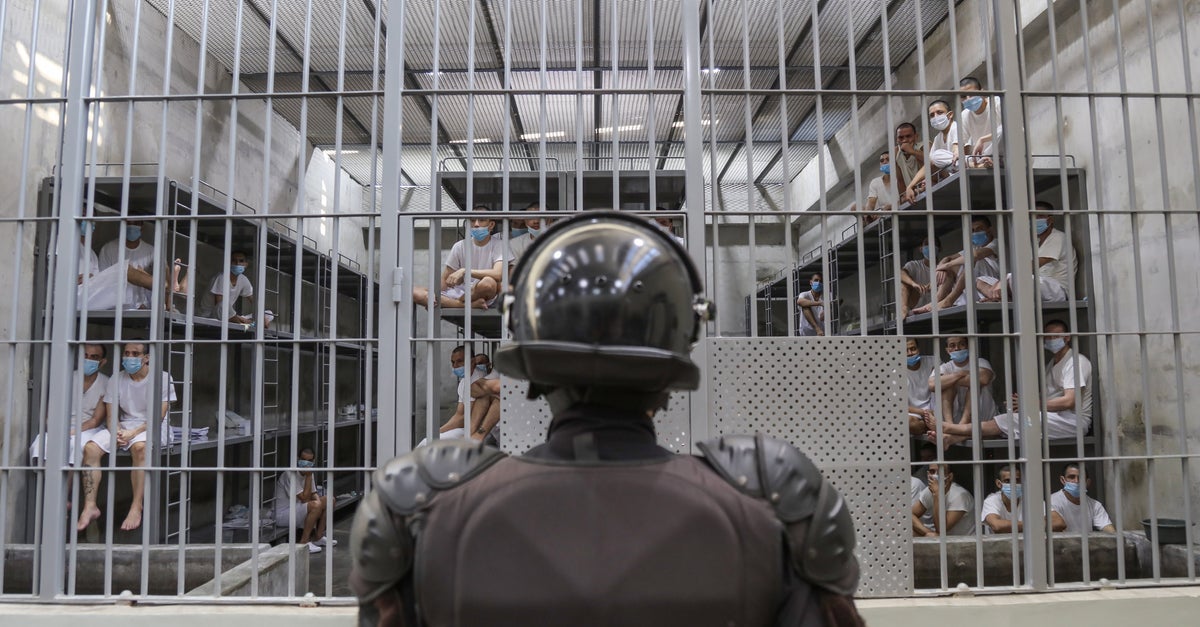
That same day, the administration rushed three flights holding 238 Venezuelans and 23 Salvadorans it claimed were gang members, without evidence in most cases, off to El Salvador. A federal judge ordered the Trump administration to halt the removals and turn the flights around, but the administration did not comply. Once in El Salvador, the migrants were sent to an infamous maximum security prison called the Centro de Confinamiento del Terrorismo (CECOT). The U.S. is reportedly paying El Salvador about $6 million to imprison the detainees.

Alex Peña via Getty Images
According to human rights observers, people imprisoned in El Salvador are often subjected to torture, severe overcrowding, inadequate food and medical care and are denied access to legal counsel. No one imprisoned at CECOT has ever left; Homeland Security Secretary Kristi Noem said on Wednesday that the migrants sent there “should stay there for the rest of their lives.”
Those who helped fight for due process protections at Guantánamo Bay under the administration of President George W. Bush view the Trump administration’s migrant detention policy as an escalation of war on terror legal tactics.
It’s “an effort to outsource detention and torture to avoid the constraints of U.S. law,” said Dixon. “It’s the natural consequence and evolution of what we’ve seen throughout the last 20 years, certainly with the CIA’s extraordinary rendition program and the use of black sites overseas.”
“The reason they’ve moved out of Guantánamo is, and this is ironic, but there’s too much rule of law there,” said Karen Greenberg, the director of the Center on National Security at Fordham Law and author of multiple books on Guantánamo and the cases that emerged from the war on terror.
The White House did not respond to a request for comment.
In 2008, the Supreme Court held in Boumediene v. Bush that although Guantánamo Bay is outside of U.S. sovereignty, people detained there have the right to challenge the legality of their detention.

“The Nation’s basic charter cannot be contracted away like this. The Constitution grants Congress and the President the power to acquire, dispose of, and govern territory, not the power to decide when and where its terms apply. To hold that the political branches may switch the Constitution on or off at will would lead to a regime in which they, not this Court, say ‘what the law is,’” Justice Anthony Kennedy wrote for the majority, citing the landmark 1803 case of Marbury v. Madison where the court declared the ability to rule on the constitutionality of laws.
“The reason they’ve moved out of Guantánamo is, and this is ironic, but there’s too much rule of law there.”
– Karen Greenberg, director of the Center on National Security at Fordham Law
But that’s exactly what the Trump administration is attempting to do by rendering migrants to CECOT. Take the case of Kilmar Abrego Garcia, a Salvadoran migrant who was sent to CECOT, despite having legal protections from being deported there. The Trump administration eventually admitted he was deported based on an “administrative error.”
When a federal judge ordered the government to facilitate Abrego Garcia’s return to the U.S., the Trump administration argued that because he was in El Salvador, they couldn’t bring him back and that courts had no authority to intervene. That line of reasoning harkened back to the Bush administration’s efforts to claim that matters of national security and foreign policy were outside of the purview of judicial review.
On Thursday, the Supreme Court unanimously upheld the federal judge’s order and directed the Trump administration to facilitate Abrego Garcia’s release from custody in El Salvador and to “ensure that his case is handled as it would have been had he not been improperly sent to El Salvador.”
The Trump administration’s argument, Justice Sonia Sotomayor wrote, “implies that it could deport and incarcerate any person, including U. S. citizens, without legal consequence, so long as it does so before a court can intervene.”
District Court Judge Paula Xinis directed the Justice Department to disclose by Friday morning the physical location and custodial status of Abrego Garcia, what steps the government had taken to facilitate his return to the U.S., and what additional steps it planned to take. Administration lawyers refused the order, claiming they are “not in a position where they ‘can’ share any information requested by the Court. That is the reality.” At a hearing later that day, Xinis ordered daily updates on those three unanswered questions.
As it stands, the Supreme Court has stated that the Trump administration cannot evade judicial scrutiny of its immigration policies by simply shipping people out of the country before they have the chance to challenge their removal. In a separate case, the Supreme Court has also held that individuals detained under the Alien Enemies Act are entitled to due process — although it vacated a lower court decision that temporarily blocked the removals. Instead, the court directed individuals to file habeas petitions challenging their detention, which will center around proving they are not members of Tren de Aragua.
Although this is far from the worst-case outcome from a 6-3 conservative Supreme Court that has demonstrated extensive deference to Trump, there are still tremendous logistical hurdles to the people imprisoned at CECOT returning home.
Take Guantánamo Bay. Even after the Supreme Court upheld habeas rights for the war on terror detainees, many of them languished at the offshore prison for more than another decade. Nine people died. Only a handful were ever convicted of a crime. Fifteen people are still there, including several who have been cleared for release.
“Their lives are unquestionably shattered and it takes a very long time to recover from that, if recovery is even possible,” Dixon said. “It’s devastating.”
The situation for those held at CECOT is even more unclear. No court has yet determined how they can file habeas petitions, given that some lawyers have reported having no contact with their clients since they were sent to El Salvador. Figuring this out will likely need to come from a future court case, which will undoubtedly be dragged on as the administration is fighting tooth-and-nail to keep those they sent to El Salvador in prison forever.
We Don’t Work For Billionaires. We Work For You.
Already contributed? Log in to hide these messages.
Even if Abrego Garcia is promptly returned home, he has already been ripped away from his wife and young child, and spent nearly a month in an infamous prison in a country he previously fled because of threats of violence.
As with Guantánamo, these detainees’ lives will be forever damaged by the administration’s choice to evade the rule of law.