
When Daniel Cox was growing up in Rochester, N.Y., he spent every Saturday night at Pizza Hut with his father and two brothers. The server got to know the family so well that when she saw their blue Dodge Caravan roll up, she would put their order in: two cheese pan pizzas and two pitchers of Pepsi.
Mr. Cox’s parents were divorced, and the Pizza Hut ritual was centering for the family. “It was a time when we were all together and everyone was enjoying the experience,” he recalled. “Who doesn’t like pizza?”
Now a father himself, Mr. Cox rarely goes out to eat with his kids. They’re in travel-soccer practice three nights a week, and his family can’t get out of the local pizzeria for less than $100. He couldn’t think of an affordable, sit-down meal they’d shared recently.
Once rapidly growing commercial marvels, casual dining chains — sit-down restaurants where middle-class families can walk in without a reservation, order from another human and share a meal — have been in decline for most of the 21st century. Last year, TGI Fridays and Red Lobster both filed for bankruptcy. Outback and Applebee’s have closed dozens of locations. Pizza Hut locations with actual dining rooms are vanishingly rare, with hundreds closing since 2019.
According to a February survey by the market research firm Datassential, 24 percent of Americans say they are having dinner at casual restaurants less often, and 29 percent are dining out less with groups of friends and family.
Mr. Cox is a pollster by profession, the director of the Survey Center on American Life, and he wondered about the effects of the chain implosions. In his latest survey on social trust and cohesion, he was moved to add questions about how often people are not just ordering food from a restaurant, but actually sitting down to eat there.
He expects to publish the results in May, but said recently, “I think what a lot of families are doing is opting out. That’s a real loss.”
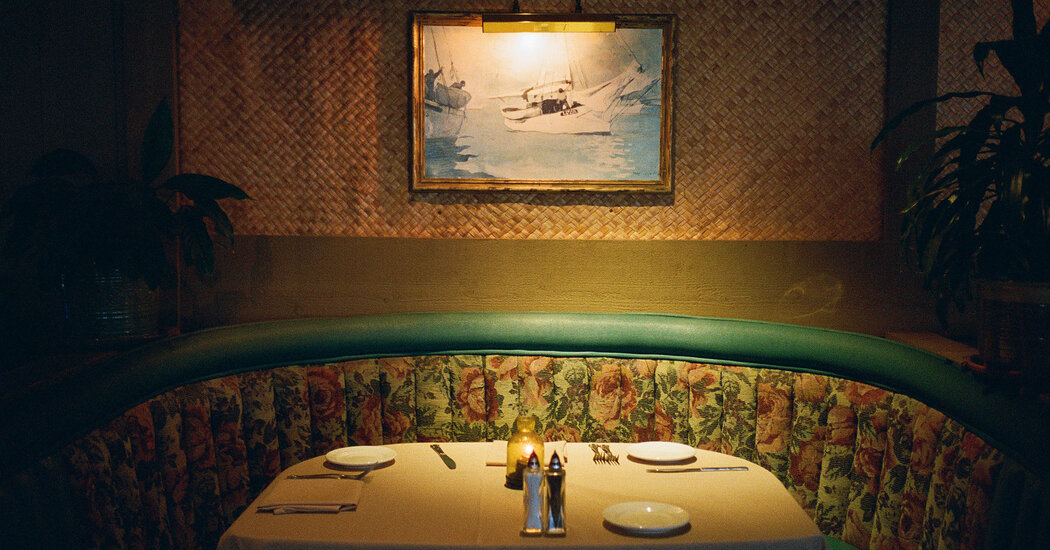
The diminishing of these spaces, along with the rise of more atomized eating habits like delivery apps and drive-throughs, signals the decline of a cherished ritual in American life: dining out with friends and family, and the human connection it brings.
Eating the Mom-and-Pops
It may seem counterintuitive to speak about these large chains as essential aspects of the social fabric. For decades, they were cast as invasive predators in American dining, displacing or devouring the small restaurants that came before.
“They are the ruination of American food,” said Jane Stern, who has dedicated roughly the last half-century to chronicling the nation’s foodways. Alongside her now-former husband, Michael Stern, she crisscrossed the country writing the canonical “Roadfood” guides.
When the couple began their journeys in the mid-1970s, many American towns were served by only a handful of restaurants. “They were places that did their own cooking, made their own menus, and had their own vision of what they should serve,” she said, tending to offer regional specialties, whether fried clams or fry bread.
When strips of chain restaurants began appearing outside the small towns, closer to the highway, those locally owned cafes often withered away. Now, instead of a dining room serving the cook’s grandmother’s recipe for rhubarb pie, glossy picture menus offer, as Ms. Stern put it, “‘Mom’s meatloaf.’ Mom who?”
These chain restaurants grew vastly in the 1980s, baby boomers buying houses and starting families in the suburbs, often with two working parents, created ideal economic conditions for new restaurants to flourish. Sit-down chains opened hundreds of domestic locations and expanded internationally. Throughout the decade one in 10 jobs added in the service sector — almost 1.8 million — were in the restaurant industry.
America’s highway interchanges spawned enormous concentrations of mass-produced nights out. In their 1994 book, “Winning the Chain Restaurant Game,” Charles Bernstein and Ron Paul wrote with a giddy, almost bewildered awe about the 180 restaurants crowded into a mile-long stretch of Belt Line Road outside Dallas.

“We once thought that the restaurant industry was an entrepreneurial business in which individual establishments would prevail,” they wrote, adding. “So it goes in the United States — for better or for worse — with chain-dominated restaurant rows and clusters everywhere from Newport Beach, Calif., to the Maryland suburbs of Washington, D.C.”
Sit-down chains entered the new century seemingly at the top of the economic heap.
The Long Decline
But the conditions that had fueled their growth also marked the beginning of a new economic order in which wealth increasingly concentrated at the top. By the 2000s, the middle class these restaurants had been custom-built to serve was shrinking as wages stagnated and neighborhoods grew more segregated by income. The chains began to falter, too.
By 2017, a number of the biggest chains were openly struggling with declining growth.
David Henkes, a senior principal at Technomic, a market research firm focused on food service, still remembers doing a study in the early 2000s about a curious new type of restaurant. It wasn’t casual dining, because people ordered at the counter. But it also wasn’t fast food — the dishes were of higher quality, and higher-priced. This eventually became known as fast casual.
“Since it got recognized as a segment distinct from fast food, it’s been on a growth tear ever since,” Mr. Henkes said.
But fast-casual brands like Chipotle didn’t succeed just by saving on the labor costs of servers and dishwashers. They offered what appeared to many consumers to be more virtuous choices. Chipotle’s most famous ad is a heartstrings-tugging film about the evils of factory farming. Another early spot simply showed someone chopping vegetables. Gone were the days of emphasizing the dining experience, as Olive Garden did with its slogan “When You’re Here, You’re Family.” Now the come-on was that when you’re here, you’re fed responsibly raised beef, to go.
This was especially effective messaging for millennials, the rising generation so prized by marketers. Food had become a means of defining their identities and values. Daphne Demetry, associate professor at the Desautels Faculty of Management at McGill University who studied the rise of gourmet food trucks during the 2010s, believes that what millennials are searching for, more than anything else, is authenticity.
“I can’t think of anything more inauthentic than TGI Fridays or Olive Garden,” she said.
Even Chip Wade, the chief executive of the Union Square Hospitality Group and a veteran of the executive ranks at Darden and Red Lobster, said his sons, ages 25 and 27, “won’t step inside a casual dining brand.” They prefer Chipotle and Shake Shack.
S. Margot Finn, a lecturer at the University of Michigan, sees another side of the cultural obsession over “good” food, widely portrayed in the media as a mass enlightenment about farm-to-table produce and regional American barbecue styles. In her 2017 book, “Discriminating Taste,” she argues that this taste shift was spurred by status anxiety. In the 1980s and ’90s, she writes, as even the upper middle class ceased making economic gains compared with the 1 percent, they turned to food as a mark of distinction and discernment.
“The things that Olive Garden and Applebee’s and TGI Fridays do for people is provide a reliable meal that will please most people,” she said. “All of those needs and desires are really pedestrian things, not distinction-gaining things.”
Dr. Finn admitted she was also guilty of the tendency. As an honorarium for a talk, she received a $250 gift certificate for any Darden restaurant. The closest one was an Olive Garden.
“It became a running joke,” she said. “My husband and I would have a sitter booked and in the car we would look at each other and say, ‘Is this the night we finally go to Olive Garden?’” But they never did. Instead, they went to “some aspirational restaurant that was probably worse than what we would have gotten at Olive Garden.”
Ordering Alone
The idea that casual dining chains are inauthentic may overlook a valuable experience these restaurants can offer. In addition to being affordable places for friends and family to share meals, recent research suggests that an Applebee’s or an Olive Garden might be the last remaining institution that brings together a cross-section of America.
In a recent paper, Nathan Wilmers and Maxim Massenkoff, studied cellphone location data to find the places where Americans were least segregated by income. Their findings demonstrated how stark the divide has become.
“It popped out of our data on this project — we didn’t set out to study these restaurants,” said Mr. Wilmers, an associate professor at M.I.T. Sloan School of Management.
Fast-food locations are so widespread that they don’t draw in people from disparate neighborhoods. Civic institutions like libraries and post offices serve their surrounding ZIP code. And independent, locally owned restaurants, despite their cultural status as scrappy underdogs, attract a more affluent clientele.
But the Chili’s, for instance, at the side of the highway is just rare enough, and just central enough, that people from a wide variety of tax brackets visit. And data drawn from social media like Facebook suggests that people who visit those restaurants more often also have more cross-class friendships.
“It’s class-neutral ground to meet up with somebody you’re connected with through work or some other setting,” Mr. Wilmers said. “If there’s only really fancy restaurants or fast food, you don’t have the social infrastructure for having comfortable meet-ups.”
The dining-room shutdowns in the early days of the pandemic, and the disruption of diners’ habits that followed, accelerated every trend dragging down the sit-down chains. Worse, the value these chains could offer through economies of scale was dealt a major blow by runaway restaurant inflation in the early 2020s, which drove restaurant prices 30 to 35 percent higher across the board, according to Mr. Henkes of Technomic.
By 2024, the long-term damage of the pandemic, and the earlier leadership shuffles, brought a number of long-lived casual dining chains to the breaking point. Red Lobster went bankrupt and shuttered 140 restaurants. (Chili’s is beating the odds, but the odds remain daunting.)
Americans are spending money at restaurants as much as ever — but really, they are buying food made by a restaurant and eating it somewhere else. Takeout and delivery apps are now ingrained habits. Drive-throughs are going strong. Random snacks and little treats are obsolescing breakfast, lunch and dinner, according to multiple analysts.
What this all means is that Americans are eating alone more than ever, and some say it’s making them miserable. Dining out by yourself can be romantic, but probably not if it’s in your car.
A recent survey by Datassential tells much of the story. Asked what they found “most luxurious” about eating out, diners ranked one thing above ingredients like lobster, premium beef or even caviar: “Dining at a sit-down restaurant in general.”
Follow New York Times Cooking on Instagram, Facebook, YouTube, TikTok and Pinterest. Get regular updates from New York Times Cooking, with recipe suggestions, cooking tips and shopping advice.