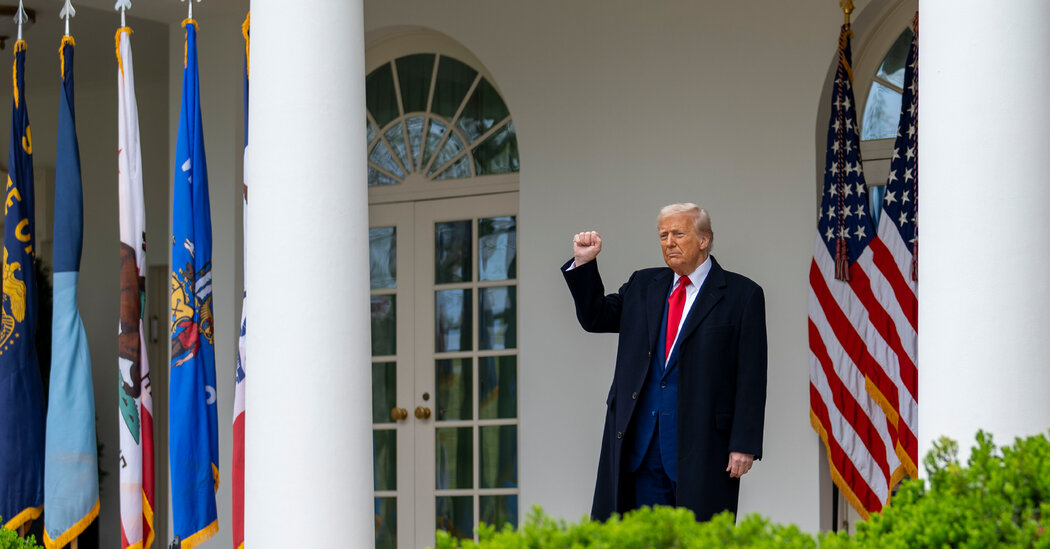

President Trump’s self-proclaimed “liberation day,” in which he announced across-the-board tariffs on the United States’ trading partners, carries an echo of another moment when an advanced Western economy threw up walls around itself.
Like Brexit, Britain’s fateful vote nearly nine years ago to leave the European Union, Mr. Trump’s tariffs struck a hammer blow at the established order. Pulling the United States out of the global economy is not unlike Britain withdrawing from a Europe-wide trading bloc, and in the view of Brexiteers, a comparable act of liberation.
The shock of Mr. Trump’s move is reverberating even more widely, given the larger size of the American economy and its place at the fulcrum of global commerce. Yet as with Brexit, its ultimate impact is unsettled: Mr. Trump could yet reverse himself, chastened by plummeting markets or mollified by one-off deals.
More important, economists say, the rise of free trade may be irreversible, its benefits so powerful that the rest of the world finds a way to keep the system going, even without its central player. For all of the setbacks to trade liberalization, and the grievances expressed in Mr. Trump’s actions, the barriers have kept falling.
The European Union, optimists point out, did not unravel after Britain’s departure. These days, the political talk in London is about ways in which Britain can draw closer to its European neighbors. Still, that sense of possibility has come only after years of turbulence. Economists expect similar chaos to buffet the global trading system as a result of Mr. Trump’s theatrical exit.
“It will not be the end of free trade, but it is certainly a retreat from unfettered free trade, which is the way the world seemed to be going,” said Eswar S. Prasad, a professor of trade policy at Cornell University. “Logically, this would be a time when the rest of the world bands together to promote free trade among themselves,” he said. “The reality is, it’s going to be every country for itself.”
Such a world will be not only unruly, but also potentially more dangerous. While trade wars do not necessarily spiral into shooting wars, historians note that some conflicts, like the War of 1812 and the Opium Wars of the mid-19th century, were rooted in trade disputes. An all-out trade war between the United States and China would inject sparks into an already combustible relationship.
“If you think about the broader conflict between the U.S. and China,” Professor Prasad said, “the economic and financial relationship provided a degree of balance. That balance is now eroding.”
Mr. Trump has stopped short of the kind of gunboat diplomacy used by Britain against China in the Opium Wars. But his pugilistic posture toward some of America’s closest trading partners, like Canada and Mexico, has deepened the sense of dislocation and could divide the response of countries.
Economists said the United States’ singular position as the biggest engine of global growth, because of its unquenchable appetite for cars manufactured in Germany and iPhones assembled in China, would make it hard for countries to reorient their trading relationships around a less welcoming American market.
That suggests many countries will end up trying to cut deals with Mr. Trump, as Prime Minister Keir Starmer said he would do last week, after the United States hit Britain with a 10 percent tariff. Others will impose retaliatory tariffs to try to better their bargaining position with the United States.
China struck swiftly on Friday, with tit-for-tat tariffs of 34 percent, after speculation that it might coordinate its response with its neighbors Japan and South Korea. Already, the European Union is warning countries that find themselves priced out of the American market not to dump cheap exports in its market.
“A lot will depend on how Europe decides to play this,” said Simon Johnson, a professor at the Sloan School of Management at M.I.T. and former chief economist at the International Monetary Fund. “The Europeans could get closer to China and pick up a lot of the slack from Vietnam.”
“That would create a big non-U.S. trading bloc,” he continued. “But I don’t think the Europeans are going to be comfortable with all those Chinese exports pouring into Europe. Where do these excess exports go?”

Europe’s likely resistance to absorbing more Chinese imports will confront China’s leaders with a thorny challenge. They can either adopt measures to make China less reliant on exports by stoking demand among their own population, something they tried to do in the past with mixed results. Or they can seek a deal with Mr. Trump, something they failed to do during his first term, despite signing a preliminary agreement.
For all of the criticism of Mr. Trump’s blunt-force methods, economists say he is responding to a genuine problem: the rise of China as a hypercompetitive trading power, one that heavily subsidizes its own companies. That has hollowed out American manufacturing, in Mr. Trump’s view; the tariffs, he claims, will bring it back.
When he came into office, President Barack Obama asked whether one of his Democratic predecessors, Bill Clinton, had given away too much in allowing China to join the World Trade Organization. Mr. Obama imposed a 35 percent tariff on China from 2009 to 2012, for dumping tires into the American market. And when President Joseph R. Biden Jr. inherited Mr. Trump’s first-term tariffs on China, he left them in place.
“The global trading system has been under pressure for a while, and that pressure has really been symbolized by the rise of China,” Professor Johnson said. “It was more damaging and disruptive than Japan.”
In 2024, Professor Johnson, along with Daron Acemoglu of M.I.T. and James A. Robinson of the University of Chicago, received the Nobel Memorial Prize in Economics for research into the colonial-era institutions that made some countries wealthier than others as they developed. One common factor, whether in Asia or Africa: “Almost all countries that escaped poverty did it through trade,” he said.
For that reason, it is unlikely that the world will drift into a state of autarky, where countries try to produce all they need within their own borders. The nature of global supply chains — from semiconductor factories in Taiwan to auto-parts suppliers in Canada — makes such economic isolation all but impossible, in any event.
The countries that will face the most pain from a trade war, economists said, are low-income exporters of commodity goods, which have little leverage to respond to Mr. Trump. Several are in Africa, among them Nigeria, which was hit with a 14 percent tariff, and Kenya and Ghana, both hit with 10 percent.
The World Trade Organization estimated that Mr. Trump’s measures, on top of his previously announced tariffs, will reduce global merchandise trade volume 1 percent in 2025, a downward revision of nearly four percentage points from its earlier forecast. A full-scale trade war would do further damage.
Still, some optimists predicted that Mr. Trump’s tariffs would accelerate the integration of other countries, either through bilateral trade deals or regional trade pacts. The United States, they note, is the only country that pulled out of the Trans-Pacific Partnership, which was later renegotiated without it, forging a trade pact among the other big economies that border the Pacific.
Even Brexit, though it drew on the same grievances about globalization as Mr. Trump’s MAGA movement, was not framed as a protectionist project. Brexiteers argued that, once freed from the shackles of the European Union, Britain could negotiate better trade deals on its own. Last week, they credited Brexit as the reason Britain’s 10 percent tariff was half that of the European Union.
“You’re going to see more countries around the world striking free trade deals, just around the U.S.,” said Jason Furman, a professor of economic policy at Harvard Kennedy School who was chairman of the Council of Economic Advisers during the Obama administration. “I see it as a turning point for the United States at the center of the global trading system,” he said, “but not for how the world thinks about free trade.”