
The call of a conch shell roused the dolphin hunters from their beds. Under moonlight, the six men shuffled to the village church.
There a priest led them in a whispered prayer, his voice barely audible over the sound of crashing waves; the tide was high that day. Saltwater pooled in parts of the village, which is on Fanalei Island, an ever-shrinking speck of land that is part of the Solomon Islands in the South Pacific.
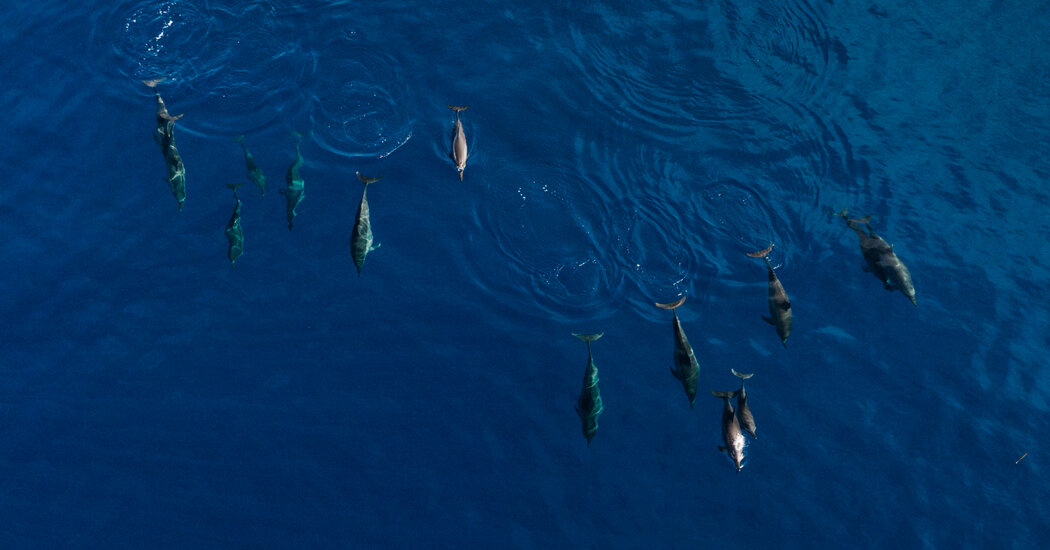
They paddled out in wooden canoes before first light, cutting through the darkness until they were miles away from shore. After hours of scanning the horizon, one of the hunters, Lesley Fugui, saw a fin slice the glassy water. He raised a 10-foot-long bamboo pole with a piece of cloth tied to the end, alerting the others of his discovery. Then he made a phone call to his wife. He had found dolphins. The hunt would begin.
These men are among the last dolphin hunters of Solomon Islands. Some conservationists say the slaughter is cruel and unnecessary. But for the 130 or so residents of Fanalei, the traditional hunt has taken on renewed urgency as climate change threatens their home. They say they need the dolphins for their lucrative teeth, which are used as local currency, to buy land on higher ground and escape their sinking home.
Each tooth fetches 3 Solomon Islands dollars (roughly $0.36) — a price set by the chiefs of Fanalei — and a single hunt of around 200 dolphins can bring in tens of thousands of dollars, more than any other economic activity on the island.
“We feel sorry, too, for killing the dolphins, but we don’t really have a choice,” Mr. Fugui said. He would be willing to abandon the hunts, he added, if there were an alternative way to secure his family’s future.
Crops can no longer be grown on Fanalei, which is about a third of the size of Central Park in New York City. The once fertile land has been ruined by encroaching saltwater. The government has promoted seaweed farming as a source of income, while overseas conservation groups have offered cash to end the hunts. But the ocean remains both an existential threat and the villagers’ most profitable resource. Government research suggests the island could be underwater by the end of the century.
“For a low-lying island like ours, we witness with our own eyes how sea rise is affecting our lives,” said Wilson Filei, the head chief of Fanalei.
Over time, dolphin teeth have allowed the villagers to pay for a new church, a sea wall and an extension to the local primary school.
During the hunting season, which runs from January through April, people here can kill up to a thousand dolphins, but the hunters say that the weather is becoming increasingly unpredictable, making it harder for them to locate and trap a pod.
While dolphin meat is eaten and bartered with neighboring islands for food, betel nuts and other products, the teeth are the true prize of the hunt. They are used for cultural activities, and families of prospective grooms buy them by the hundreds to give to a woman during a traditional bride price ceremony.
In recent years, most villagers have fled to a neighboring island. They continue to hunt dolphins from there, saying they need to buy more land to house those left behind and support their growing population.
Dolphin hunting is a community affair in Fanalei. When Mr. Fugui raised his flag that morning, he set off a cacophony of delight. Children climbed trees to watch the hunters and cheered “kirio” — dolphin in the local Lau language — so that every resident would know that the hunt had started. Men in canoes hanging close to shore broke through the waves into the open ocean to help the hunters form a semicircle around the dolphins and corral them to land.
The teeth, once collected, are shared among every family according to a strict tier system: The hunters get the largest share (“first prize”); married men who didn’t participate get the next largest portion; and the remaining teeth are divided among widows, orphans and other households without a male representative.

Village leaders also set aside a portion of the teeth in what they call a “community basket” for major works. One day, they hope this will include the purchase of land to expand a resettlement village on the larger South Malaita Island.
These shares have been an important safety net to residents like Eddie Sua and his family. Mr. Sua was once a skilled fisherman and dolphin hunter who became mysteriously paralyzed from the neck down two years ago, and he has been bedridden ever since. These days, during high tide, his home floods.
“We have to be scared of these floods, because that’s what will make us act to save our lives,” he said, watching the saltwater lick at the sides of his bed.
Dolphin hunting is very good or “good tumas,” Mr. Sua’s wife, Florence Bobo, said in the local pijin language, especially now that her husband is unable to support the family like he once did. They both hope to eventually have enough money to relocate off the island.
“If we didn’t have dolphin teeth, we’d have no other choice but to eat rocks,” Mr. Sua joked.
But a successful hunt is never a certainty. After spotting the dolphins, Mr. Fugui and the other hunters started beating fist-size rocks under the water to drive the pod toward the shore. But a trawler passed behind them, the roar of its engine drowning out the dull thuds of their rocks. The dolphins scattered and the men returned empty-handed.
Halfway through this year’s season, there was only one successful hunt in Solomon Islands, where a village near Fanalei killed over 300 dolphins.
Experts say it’s unclear whether dolphin hunting is sustainable. Rochelle Constantine, a marine biologist who teaches at the University of Auckland, and Kabini Afia, a climate and environmental researcher from the Solomon Islands, said that some of the more commonly hunted species appear to have healthy populations. But the effects of the hunt are still unclear on more coastal and smaller dolphins.
For the people of Fanalei, the more pressing question isn’t the future of the dolphins — it’s their own survival in the face of rising seas.
“Dolphin hunting may be our identity,” Mr. Fugui said, “but our lives and the lives of our children — that’s what’s important.”