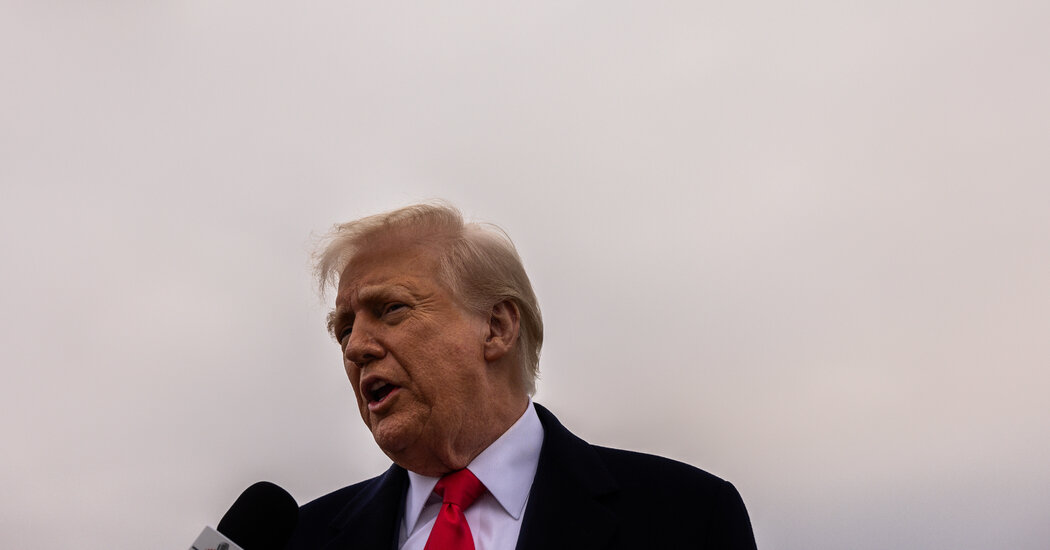

Presidents usually do all they can to avoid recessions, so much so that they avoid even saying the word.
But President Trump and his advisers in recent weeks have offered a very different message. Yes, a recession is possible, they have said. Maybe one wouldn’t even be that bad.
Howard Lutnick, the commerce secretary, has said Mr. Trump’s policies are “worth it” even if they cause a recession. Scott Bessent, the Treasury secretary, has said the economy may need a “detox period” after becoming dependent on government spending. And Mr. Trump has said there will be a “period of transition” as his policies take effect.
Such comments may partly reflect an effort to align political statements with economic reality. Mr. Trump promised to end inflation “starting on Day 1” and declared, in his inaugural address, that “the golden age of America begins right now.”
Instead, inflation has remained stubborn, and while Mr. Trump has been in office less than two months, economists warn that his tariffs are likely to make it worse. Measures of consumer and business confidence have plummeted and stock prices have tumbled, attributable in large part to Mr. Trump’s policies and the uncertainty they have caused.
“It’s the kind of language that you use when your policy isn’t going great and you can see that it’s actively harming people,” said Sean Vanatta, a financial historian at the University of Glasgow in Scotland.
The Trump administration and its supporters argue that their goals go beyond political messaging. They say they are looking to reduce imports, bring back manufacturing jobs and “re-industrialize” the American economy. Even if doing so requires higher prices in the short run, they argue, American workers will win out in the end.
“The trade-off of short-term pain for long-term gain can be very real and an important thing to pursue,” said Oren Cass, founder of American Compass, a conservative research organization that has backed many of Mr. Trump’s economic policies. “It’s actually incredibly heartening to see that we might have some political leaders who are willing to speak honestly about that.”
But even Mr. Cass was critical of the administration’s on-again, off-again approach to tariffs, which he said risked undermining the policy’s effectiveness.
And while many economists are sympathetic to the idea that presidents must sometimes cause temporary hardship in the pursuit of longer-run goals, few are willing to defend the specific set of policies the Trump administration is adopting.
“The idea of short-term pain for long-term gain is not a crazy idea in and of itself,” said Greg Mankiw, a Harvard economist who served as chairman of the Council of Economic Advisers under President George W. Bush. But Mr. Trump’s trade policies, he said, are “short-term pain to get more long-term pain.”
Trade wars, tariffs and prices
One form of short-term pain that Mr. Trump and his aides have acknowledged is that tariffs will raise the price of imported goods. Mr. Bessent has framed that as a necessary if difficult step to wean the U.S. economy off cheap foreign goods, particularly from China.
“The American dream is not contingent on cheap baubles from China,” Mr. Bessent said on “Meet the Press” on Sunday. “It is more than that. And we are focused on affordability, but it’s mortgages, it’s cars, it’s real wage gains.”
Most economists, however, reject the idea that reducing imports will leave Americans better off overall. Competition from lower-cost producers overseas has hurt some U.S. industries, they acknowledge, but made Americans richer on average — lower prices are in effect a pay increase, leaving consumers with more money to spend on goods and services.

But even if the goal is to reduce imports, economists say broad-based tariffs like the ones Mr. Trump has threatened and imposed will be ineffective. That’s because the tariffs hit not just consumer goods but the parts and materials that U.S. manufacturers use to produce their products — making them more expensive for domestic and foreign consumers alike.
“If their goal is to re-industrialize, I think they’re going to learn that tariffs actually set them back on that,” said Kimberly Clausing, a professor at the University of California, Los Angeles, who served in the Treasury Department during the Biden administration. “Making things in America is much harder when all the inputs are more expensive.”
Some economists in recent years have turned a more skeptical eye on their profession’s longstanding orthodoxy on free trade. David Autor, an M.I.T. economist, has done influential research finding that the flood of cheap goods from China beginning in 2000 led to the rapid destruction of U.S. manufacturing jobs, leaving many workers and communities worse off in the long-run — an episode that has become known as the “China shock.”
But tariffs today can’t reverse a shock that occurred decades ago, Mr. Autor said — and, in any case, there is little sense in trying to bring back the textile mills and mass-market-furniture factories that the China shock wiped out.
Instead, Mr. Autor said, policymakers should focus on preserving and strengthening the higher-value manufacturing industries that drive innovation. Tariffs can be part of that strategy, he said, but they should be focused on specific sectors and paired with subsidies to encourage investment. The Biden administration pursued that strategy with laws promoting investment in semiconductor manufacturing and green energy, but Mr. Trump has, so far, abandoned it.
“It cannot be just a tariff story,” Mr. Autor said. “There has to be investment.”
Deficits and spending
Economists are more sympathetic to another of Mr. Bessent’s arguments: that the economy has become too dependent on government spending.
Economists across the political spectrum agree that the government should not be running multitrillion-dollar deficits during a period of low unemployment, when tax revenues are ordinarily strong and government spending isn’t necessary to stimulate growth. Cutting deficits now might be difficult — requiring spending cuts and tax increases — but waiting until the deficit becomes a crisis would be much more so.
“The longer we wait, the more the pain is going to be,” said Alan J. Auerbach, an economist at the University of California, Berkeley, who has spent decades studying the federal budget.
The trouble, Mr. Auerbach and other economists say, is that nothing the Trump administration has proposed would make a meaningful dent in the deficit. Elon Musk’s Department of Government Efficiency has slashed jobs and shuttered programs, but those efforts touch only a tiny fraction of the federal budget.
Congressional Republicans, in the budget framework they passed last month, proposed more substantial cuts by targeting a major program, Medicaid. But rather than pair those cuts with tax increases, the Republican plan would extend Mr. Trump’s 2017 tax cuts, ultimately resulting in a huge increase to the deficit.
Who bears the costs?
The 2017 tax cuts disproportionately benefited higher-income households, according to most independent analyses. Medicaid cuts would overwhelmingly hurt low- and moderate-income families, as would cuts to other government services. Tariffs likewise tend to be hardest on poorer households, which spend more of their income on food, clothes and other imported goods.
The short-term pain created by the administration’s policies, in other words, could fall hardest on low-income Americans — many of whom voted for Mr. Trump in hopes of improving their economic situation.
“It’s really hard to see how the Trump voters come out ahead,” Ms. Clausing, the former Treasury official, said. “Prices are going to be higher, disruptions are going to be higher and the safety net is going to get cut.”
Even some defenders of Mr. Trump’s policies, such as Mr. Cass, say cutting benefits to pay for tax cuts runs counter to the administration’s stated goal of restoring the middle class.
“The tax piece of this is definitely a confounding factor,” he said.
A recession, too, would be particularly hard on lower-wage and less educated workers, who are disproportionately Black and Hispanic, said Jessica Fulton, vice president of policy at the Joint Center for Political and Economic Studies, a research organization focused on issues affecting Black Americans.
And even if a downturn is short-lived, the damage might not be. Economic research has shown that people who lose jobs in a recession, or who graduate into one, can suffer long-term career consequences.
“To talk about causing temporary harm ignores the fact that people will be feeling the results of decisions that this administration makes for years to come,” Ms. Fulton said.