
Sweeping tariffs on imports from Canada, Mexico and China went into effect just after midnight on Tuesday, raising U.S. tariffs to levels not seen in decades and rattling foreign governments and businesses that depend on international trade.
As of 12:01 a.m. Tuesday, the Trump administration added a 25 percent tariff on all imports from Canada and Mexico. The administration also added another 10 percent tariff on all imports from China. That comes on top of a 10 percent tariff on Chinese goods put into effect just one month ago and a variety of older levies, including those that remain from the China trade war in Mr. Trump’s first term.
The tariffs will make good on President Trump’s campaign promise to rework America’s trade relations, and they are likely to encourage some manufacturers who want to sell to American customers to set up factories in the United States, instead of other countries.
But by altering the terms of trade between the United States and its largest economic partners, the tariffs will also probably rattle supply chains, strain some of the country’s most important diplomatic relationships and add significant costs for American consumers and manufacturers.
Canada, Mexico and China are the three largest trading partners of the United States, accounting for more than 40 percent of both U.S. imports and exports last year. The three countries supply the bulk of crude oil, beer, copper wire, toilet paper, hot-rolled iron, cucumbers and chocolate imported by the United States, as well as a dizzying array of other products.
The tariffs came as somewhat of a surprise, given that Mexico and Canada have gone to great lengths in recent weeks to convince the president that they were stepping up enforcement of their borders. The president initially threatened in November to impose the tariffs, saying that the three countries were not doing enough to halt the flow of drugs and migrants into the United States.
On Monday, however, Mr. Trump appeared to change his terms, saying that Canada and Mexico needed to relocate auto factories and other manufacturing to the United States.
“What they have to do is build their car plants, frankly, and other things in the United States, in which case they have no tariffs,” he said.
Prime Minister Justin Trudeau of Canada said on Monday evening that his country would respond with its own tariffs of 25 percent on $155 billion of American goods. Tariffs on $30 billion would go into effect Tuesday, and the remainder in 21 days, he said.
Mr. Trudeau said that less than 1 percent of the fentanyl intercepted at the U.S. border came from Canada, but that the country had still worked to stop its flow, pushing fentanyl seizures to near zero by January.
“Canada will not let this unjustified decision go unanswered,” Mr. Trudeau said.
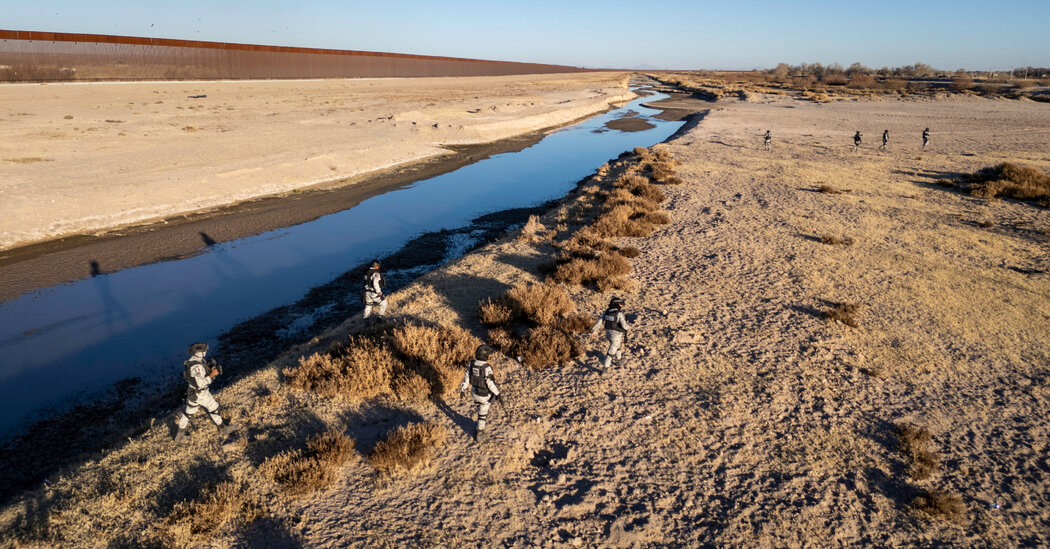
The Mexican government had also gone to great lengths to step up its border enforcement, including cracking down on the cartels producing fentanyl and handing over dozens of top cartel operatives to the United States. Mexico also pledged to deploy 10,000 National Guard troops to help deter migration, building on earlier efforts to disassemble migrant caravans well before they reach the border with the United States.
Activity at the border had already calmed by the time Mr. Trump took office in January, but in recent weeks border crossings have declined to the lowest in recent history. At one point in February, U.S. personnel on the Mexican border encountered only 200 migrants in a single day, levels that were once unthinkable.
In Canada, which is a minuscule source of fentanyl compared with Mexico, the threat of tariffs sparked frustration and outrage. It also led to a surge of patriotism and anti-American sentiment, which was intensified by Mr. Trump’s repeated calls for the annexation of Canada.

Shortly after Mr. Trump, as president-elect, first made the tariff threat in November, Mr. Trudeau flew to Florida to meet him at Mar-a-Lago, the president’s estate and private club. Canada began assembling a list of retaliatory tariffs and put together a plan to increase security at its border. That included appointing a “fentanyl czar,” leasing Black Hawk helicopters for Royal Canadian Mounted Police patrols and buying a fleet of drones.
Days before the tariffs were imposed, some business leaders who are members of a Canada-U.S. relations group that Mr. Trudeau set up after the tariff threat were already pessimistic that the lobbying, the alliance building and the border strengthening would bring another last-minute reprieve.
Steve MacKinnon, Canada’s employment minister, said on Monday that the government would move to introduce extra wage supports for workers who are left jobless because of the tariffs.
Economists have estimated that the tariffs will lower economic growth throughout North America, but that they will hit Canada and Mexico the hardest, given that those countries send roughly 80 percent of their exports to the United States.
In contrast, China sends only about 15 percent of its exports to the United States, so it is much less exposed to the tariffs. While Canada and Mexico worked hard to appease Mr. Trump, China did not make similar overtures. The Chinese government did not want to be seen as pleading and was wary of offering concessions before it understood the parameters of the negotiation, people familiar with their thinking said.
In a statement, a spokesperson for the Chinese Ministry of Commerce said China was “strongly dissatisfied” and would take countermeasures to “safeguard its own rights and interests.” The spokesperson accused the United States of disregarding facts and international trade rules, and described the episode as “bullying.”
The tariffs on Canada, Mexico and China come in addition to a raft of other tariff proposals Mr. Trump has made this year. The administration is set to introduce tariffs on foreign steel and aluminum on March 12, and has suggested that it will introduce a variety of others, including on foreign cars, in April. Mr. Trump has also opened trade investigations that could result in tariffs on copper and timber.
It remains to be seen whether business executives can persuade Mr. Trump to walk back any of these plans. Gustavo Flores-Macías, a professor of government and public policy at Cornell University, said the stock market had already erased the gains of a “Trump bump” since the president’s election.
Mr. Flores-Macías said the tariffs would harm industries, particularly the automotive sector. Just short of 40 percent of the cars and trucks sold in the United States are imported, according to JATO Dynamics, an automotive research firm, with Mexico the biggest supplier of imported cars.
“The U.S. economy is larger and can better absorb the negative consequences of a trade war, but a simultaneous trade war with its three main trade partners (once tariffs against China are included) will affect all parties negatively,” Mr. Flores-Macías wrote in an email.
The International Association of Machinists and Aerospace Workers, which represents workers in the aerospace, railroad, health care and automotive industries in the United States and Canada, strongly condemned what it called a “reckless decision” and “an unjustified attack on a trusted ally.”
“Canada is not the enemy,” said Brian Bryant, the group’s international president. “This decision will disrupt industries that rely on integrated supply chains, hurting workers on both sides of the border.”
“Tariffs are taxes on Americans and American business, not foreign governments or companies,” said Gary Shapiro, the chief executive of the Consumer Technology Association, a trade group for tech companies. “Adding tariffs on imports from Canada, Mexico and China will raise prices for Americans at a time when inflation and affordability is their top concern.”
Other executives say that they support the goal of fighting the fentanyl trade, but that tariffs will have other economic effects, like chilling hiring and weighing on consumers.
Casey Hite, the chief executive of Aeroflow Health, which provides breast pumps, CPAP machines, diabetic testing kits and diapers to people covered by insurance, said
that if tariffs erased the profit margins for certain medical devices, his company would probably not offer those models. That would mean patients would have fewer breast pumps or CPAP machines to choose from.
The company, whose headquarters are in Asheville, N.C., and which employs more than 1,000 people, may also pull back on hiring and other expansions, he said. As time goes on, Aeroflow will work to renegotiate its contracts with health insurers, which will probably pass on their costs to patients.
“In the short term, tariffs can limit access,” Mr. Hite said. “In the long term, folks will see that in the form of increased insurance rates.”
Jack Ewing contributed reporting.