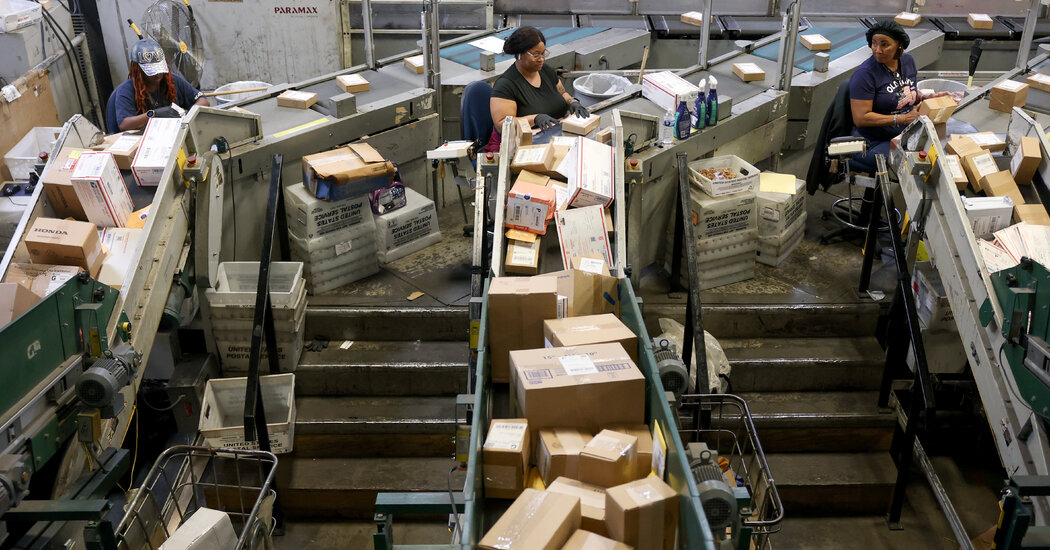

The United States Postal Service announced Tuesday that it had temporarily stopped accepting packages from China and Hong Kong, hours after an order by President Trump took effect that ended duty-free handling of many smaller parcels.
Mr. Trump ordered on Saturday that all goods leaving China starting on Tuesday must follow the rules for higher-value shipments. Until the change, parcels worth up to $800 apiece were not required to include detailed information on their contents and were not subject to tariffs.
The United States imports close to four million of such lower-value parcels a day with little or no customs inspection and no duties collected — with most of them coming from China.
The Trump administration and other critics have contended that allowing these packages into the United States has created a conduit for fentanyl, a synthetic opioid, and related supplies to enter the United States.
But the duty-free provision on lower-value parcels, known as the de minimis rule, has also been used by many e-commerce companies to bring regular consumer items from China into the United States without paying tariffs on them.
FedEx and UPS are also affected by the change in customs rules, as they move a large portion of the parcels, running frequent cargo flights from China to the United States. Neither company has responded yet to questions about how they will handle the new rules.
The de minimis provision was included in a broader order by Mr. Trump that imposed an extra 10 percent tariff on all imports from China.
Lower-value parcels from China, which previously were tariff-free, now face not only the 10 percent tariff but also the many complex tariffs on every category of goods that these shipments previously skirted entirely.
A spokeswoman for the U.S. Postal Service did not respond to a question about whether stoppages were related to the change in trade rules, referring to a statement the service had released announcing the suspension.
Customs and Border Protection, which is responsible for inspecting imports and assessing tariffs, did not immediately respond to a request for comment. The White House did not immediately provide comment. Trade lawyers said the postal stoppage was caused by the executive order.
The rapid rollout of Mr. Trump’s trade orders left little time for postal and customs officials to prepare to scrutinize so many packages. Mr. Trump said on Jan. 22 that he would put tariffs on Canada and Mexico on Feb. 1.
He added China to the list on Jan. 23, but did not say then that he would include a ban on duty-free handling of shipments under $800 from any of the three countries. He signed the executive orders on Feb. 1, including the de minimis ban for all three countries, to take effect just three days later. On Monday, he suspended on Monday the orders on Canada and Mexico, but left in place the tariffs and de minimis rule on China.
Supporters of de minimis have long said that eliminating the provision would increase the burden on U.S. customs officials. U.S. Customs and Border Protection is also the primary agency responsible for carrying out much of Mr. Trump’s enforcement actions at the border.
In an online event in October, Ralph Carter, the vice president of regulatory affairs at FedEx, observed that resources were stretched for U.S. customs officials and that a change to de minimis rules could lead to bottlenecks for shippers.

“If we convert these millions of shipments from de minimis into formal, informal clearances, we’re going to have serious supply chain backups, because there simply isn’t the resources to manage that,” he said. “And so that’s going to affect all importers, not just importers of de minimis.”
Neil Saunders, managing director at GlobalData Retail, a research and consulting firm, said that the decision to stop international packages coming from China and Hong Kong would have its greatest impact on marketplaces like Shein, Temu and to some extent Amazon.
“They are the ones putting millions of packages into the system each week,” Mr. Saunders said in an interview. “That route has now been cut off at least temporarily.”
Shein and Temu are two of the largest e-commerce companies that connect low-cost Chinese factories to millions of American households. Shein declined on Tuesday to comment on the new rules on small packages, while Temu has not yet responded to questions sent on Monday. Amazon also did not immediately respond to a request for comment.
Raising the duty-free minimum has allowed millions of American households to buy low-cost goods from China. But U.S. manufacturers in sectors like textiles and apparel have contended that the imports of small parcels have undermined their ability to stay in business.
The rapid expansion of e-commerce has for years posed a dilemma for Customs and Border Protection. Customs officials were already starting to be overwhelmed by small e-commerce parcels in 2016, when they persuaded Congress and the Obama administration to raise the minimum value for customs inspection and tariff collection to $800, from $200.
But with the increase in the duty-free limit, the number of duty-free parcels has risen tenfold since 2016. Congress has been debating for the past year how to change the rule on duty-free parcels.
Proposals in Congress had tended to focus on matching the policies of China, which discourages de minimis imports. China restricts de minimis imports to a few kinds of products, closely checks what is imported and sets very low limits on the value of each parcel — for many products, less than $100.
The end of the American de minimis rule for goods from China could particularly complicate American imports of clothing. American law bars the import of any goods produced with forced labor in Xinjiang, a region of northwest China where Beijing has ordered a far-reaching crackdown on Uyghurs and other predominantly Muslim minorities.
The legislation requires importers to prove that goods with any content from Xinjiang did not involve forced labor — a hard legal standard to meet because China does not allow independent labor inspections there. And Xinjiang produces much of China’s cotton.
The de minimis imports skirted those rules. The suspension of de minimis rules may make it harder for companies to ship such goods from China.
Traditional retailers with stores, like Gap, ship their merchandise in bulk from overseas and pay tariffs on it, and already need to comply with legislation against forced labor. So they may be affected much less by the rule change than e-commerce companies.