
Four months ago, China’s leaders announced what seemed like a straightforward and proven plan to recharge the economy: Subsidize consumers who want to replace old cars and household appliances.
The early results are not promising.
Only 113,000 cars qualified for trade-in subsidies through June 25 — a blip in a country where monthly sales exceed two million cars. And buyers of new appliances such as washing machines and refrigerators are being offered discounts of only about 10 percent, depending on what city they live in.
The incentives are not enough to bring customers into stores.
“If it is not needed, people will not go out of their way to find an old machine to participate,” said Dai Yu, the manager of an appliance store in Jingdezhen, a city in Jiangxi Province in south-central China.
The idea of providing financial incentives to spur consumer spending is not new.
In 2009, the United States, Germany, France, Spain and Austria offered so-called cash for clunkers programs to revive car sales. They paid households to scrap gas guzzlers and replace them with newer cars with better fuel economy. China itself gave extensive tax cuts and subsidies for consumers to buy new cars and household appliances. Prices for many appliances were cut in half, particularly for rural residents, and sales surged.
The current strategy has been held back by tight eligibility restrictions and limited financing. As often happens, China’s central government has turned the appliance program almost entirely over to provincial and local governments, many of which are struggling with heavy debts and reluctant to offer more generous subsidies. The central government, which has fewer debts, pays 60 percent of the cost of the car subsidies.
So the effort has not yet fixed one of China’s biggest economic problems right now: weak spending by consumers. Factories have responded by chasing more customers overseas, but that has incited a backlash and trade restrictions by governments in Europe, the United States and developing countries.
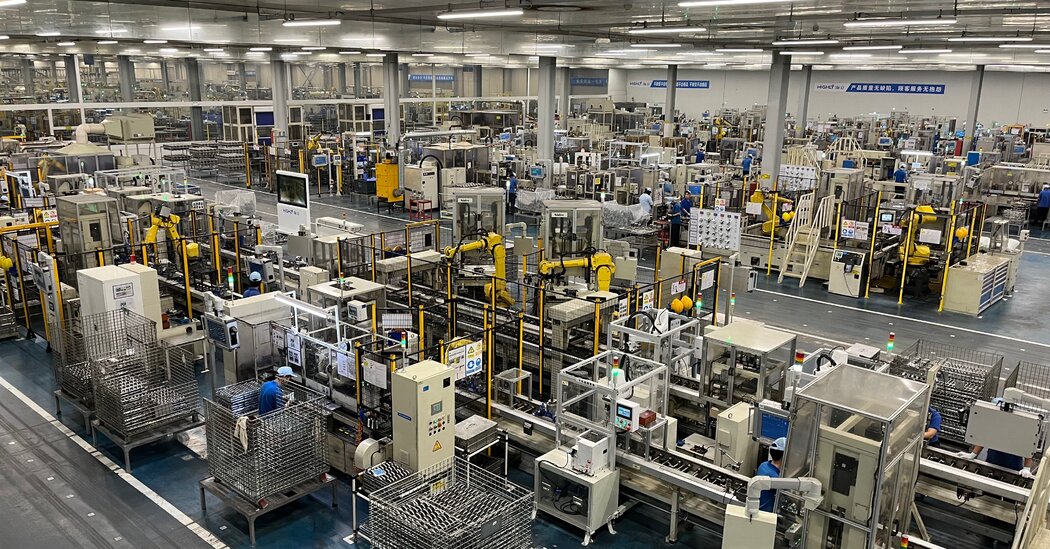
The weakness of the cash for clunkers program is evident at an electric car factory and an air-conditioner compressor factory in Nanchang, the capital of Jiangxi.
The compressor factory’s assembly lines, a maze of yellow robots interspersed with teams of workers dressed in blue, have been running on only one shift a day.
Several miles away, a money-losing electric car factory is assembling fewer than 30,000 cars a year, even though it has the capacity to make 100,000.
Factories across China that make electric cars or household appliances are hustling to find export markets. The electric car factory in Nanchang, for example, ships about 3,000 cars a year overseas, but does so in unprofitably small batches to 30 countries.
Often owned partly or entirely by local or provincial governments, factories need exports to keep their workers busy. And despite weak domestic sales, they are hesitant to lay off workers.

A housing market crash has left millions of Chinese families wary of big-ticket purchases. Yet the state-controlled banking system, acting under direction from Beijing, is lending hundreds of billions of dollars a year to build and expand more factories.
Chinese automakers have gone from selling almost no electric cars in Europe four years ago to capturing about a quarter of its market this year. That success, together with evidence that China has subsidized its electric car industry, has prompted the European Union to draft tariffs on these imports.
European and Chinese officials agreed on last month to hold talks to avoid tariffs, but the two sides remain far apart. European officials insist that the electric vehicle supply chain in China is subsidized. Chinese officials affirm that there are no subsidies, and that their industry’s growth reflects innovation and manufacturing efficiency.
The cash for clunkers plan to stir consumer spending has high-level political support. In March, Premier Li Qiang, China’s second-highest leader after President Xi Jinping, ordered that local and provincial governments should “promote large-scale equipment upgrades and trade-in of old consumer goods.”
But debt-ridden local governments have not put enough money into the programs. The national government has been reluctant to help out. As a result, the discounts being offered to consumers have ranged from modest to penurious.
Luo Yu, an office worker in Jingdezhen, walked out of Mr. Dai’s appliance store with empty hands on a recent evening, unimpressed with a 10 percent discount. “Why replace them if they’re not broken?” she asked.
Subsidies for electric cars are scarcely more generous. Most cars must be at least 13 years old to qualify for replacement. Only about 10 million of the country’s 250 million registered cars are eligible.
Owners of old cars receive a subsidy of $1,380 — a tenth or less of the cost of all but the cheapest cars — if they trade them in for a new battery-electric car or plug-in hybrid car. The subsidy is $960 if they trade in an old, heavily polluting car for a new model with a small gasoline engine that meets the latest emission standards.
By comparison, the United States gave subsidies of $4,500 per car in 2009. That cash for clunkers program was so popular that General Motors, Ford Motor and other automakers increased factory output and called back some idled workers.
China’s automakers and banks are also providing discounts and loans to help sales. But industry leaders acknowledged that many car shoppers were unenthusiastic.
“Consumers are still reluctant to trade in their cars for now,” said Cui Dongshu, the secretary general of the China Passenger Car Association. “It will be a gradual process.”
Xu Xingfeng, the director of the commerce ministry’s department of consumer promotion, said at a news conference last week that the pace of car trade-ins “showed an accelerating growth trend.”
Sales of battery-electric cars and plug-in hybrid cars are rising in China. But that increase has been offset by a drop in sales of gasoline-powered cars. Total car sales in China in May were little changed from the same month last year.
Appliance sales were fairly strong this spring, but not enough to keep up with factory output. Manufacturers with overcapacity are cutting prices to compete, part of a broad decline in many prices in China. They are finding customers overseas: The number of appliances exported rose 27 percent in May from a year earlier.
With cash for clunkers, the government pushes consumers to buy from big manufacturing industries. But in cities like Jingdezhen, a pottery-making hub for more than 1,000 years, there are hints that China’s consumers would spend more if the government gave them cash instead and let them choose how to spend it.
Thousands of young people, including many recent graduates who face a very tough job market, throng Jingdezhen’s 31-acre open-air pottery market. They spend lots of time but little money.
Wang Yajun has long sold hand-painted statuettes of Chinese gods at her booth. She now paints and sells less expensive refrigerator magnets as well.
“People find it hard to accept products with higher prices,” she said. “Cheap products may perform better.”
Li You contributed research.