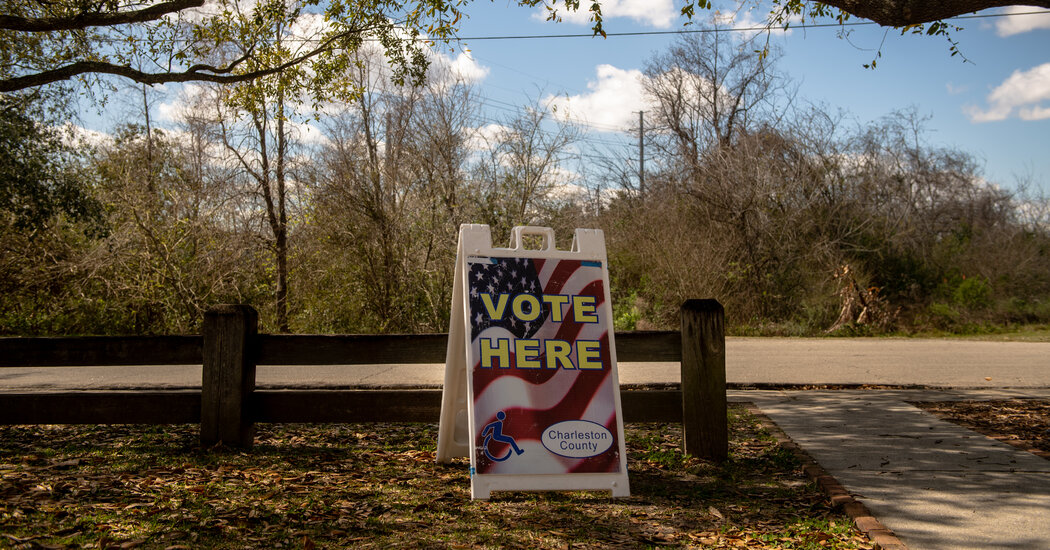

The Supreme Court cleared the way on Thursday for South Carolina to keep using a congressional map that a lower court had deemed an unconstitutional racial gerrymander that resulted in the “bleaching of African American voters” from a district.
The conservative majority, by a 6-to-3 vote, returned the case to the lower court, handing a victory to Republicans by allowing them to maintain boundaries that helped make the district in question a party stronghold.
The immediate effect of the ruling will be limited, as the court’s delay in ruling had already ensured that this year’s elections would take place under the contested map. But the majority opinion, written by Justice Samuel A. Alito Jr., will have an impact beyond South Carolina in the years to come, said Richard L. Hasen, a law professor at the University of California, Los Angeles.
“Justice Alito for a court majority has once again come up with a legal framework that makes it easier for Republican states to engage in redistricting to help white Republicans maximize their political power,” Professor Hasen said.
The ruling was the latest in a series of closely divided decisions on elections that are a distinctive element of the work of the court led by Chief Justice John G. Roberts Jr., including ones that have amplified the role of money in politics, made it easier to restrict voting and exempted partisan gerrymandering from review in federal court.
The trend is not entirely uniform, as the court ruled last year that Alabama lawmakers had diluted the power of Black voters in drawing a congressional voting map. But the overall pattern has been to limit the oversight of elections by Congress and the federal courts, often in ways that have benefited Republicans.
In the case decided Thursday, Alexander v. South Carolina State Conference of the N.A.A.C.P., No. 22-807, the court’s majority held that courts must generally credit lawmakers’ assertions that their goal in redistricting was partisan, which is permissible, rather than based on race, which is not. “We start with a presumption that the legislature acted in good faith,” Justice Alito wrote.
Quoting earlier decisions, he wrote that courts should avoid grave accusations against state lawmakers.
“When a federal court finds that race drove a legislature’s districting decisions,” he wrote, “it is declaring that the legislature engaged in ‘offensive and demeaning’ conduct that ‘bears an uncomfortable resemblance to political apartheid.’ We should not be quick to hurl such accusations at the political branches.”
In dissent, Justice Elena Kagan accused the majority of erecting hurdles to make it all but impossible to challenge voting maps as racial gerrymanders.
“The proper response to this case is not to throw up novel roadblocks enabling South Carolina to continue dividing citizens along racial lines,” she wrote, in an opinion joined by Justices Sonia Sotomayor and Ketanji Brown Jackson. “It is to respect the plausible — no, the more than plausible — findings of the district court that the state engaged in race-based districting. And to tell the state that it must redraw” the challenged district, “this time without targeting African-American citizens.”
Chief Justice Roberts and Justice Clarence Thomas, Neil M. Gorsuch, Brett M. Kavanaugh and Amy Coney Barrett joined Justice Alito’s majority opinion. In a concurring opinion, Justice Thomas said he would have gone further, getting out of the business of assessing claims of racial gerrymandering entirely.
“The court has no power to decide these types of claims,” he wrote. “Drawing political districts is a task for politicians, not federal judges. There are no judicially manageable standards for resolving claims about districting, and, regardless, the Constitution commits those issues exclusively to the political branches.”
A unanimous three-judge panel of the Federal District Court in Columbia, S.C., ruled in early 2023 that the state’s First Congressional District, drawn after the 2020 census, violated the Constitution by making race the predominant factor.

The panel put its decision on hold while Republican lawmakers appealed to the Supreme Court, and the parties asked the justices to render a decision by Jan. 1. After that deadline passed, the panel said in March that the 2024 election would have to take place under the map it had rejected as unconstitutional.
“With the primary election procedures rapidly approaching, the appeal before the Supreme Court still pending and no remedial plan in place,” the panel wrote, “the ideal must bend to the practical.”
In effect, the Supreme Court’s inaction had decided the case for the current election cycle.
The contested district, anchored in Charleston, had elected a Republican every year since 1980, with the exception of 2018. But the 2020 race was close, with less than one percentage point separating the candidates, and Republican lawmakers “sought to create a stronger Republican tilt” in the district after the 2020 census, the panel wrote.
The lawmakers achieved that goal, the panel found, in part by the “bleaching of African American voters out of the Charleston County portion of Congressional District No. 1.”
The new House map moved 62 percent of Black voters in Charleston County from the First District to the Sixth District, a seat that Representative James E. Clyburn, a Black Democrat, has held for 31 years.
The move helped make the new First District a Republican stronghold. In November, Nancy Mace, the Republican incumbent, won re-election by 14 percentage points.
Republican lawmakers acknowledged that they had redrawn the First District for partisan gain. But they said they had not considered race in the process.
The panel ruled that the district’s boundaries violated the Constitution. But the panel rejected challenges to two other House voting districts, saying that civil rights groups had failed to demonstrate that the districts had been predominantly drawn to dilute Black voting power.
The Supreme Court has called for very close scrutiny of a state’s actions when race is shown to be the predominant reason for drawing legislative districts. That principle, rooted in the Constitution’s equal protection clause, is often invoked to limit the creation of districts that empower minority voters.
In this case, though, the challenge came from the opposite direction, with civil rights groups saying that the map hurt Black voters by moving them from one congressional district to another.
In their Supreme Court appeal, South Carolina Republicans argued that the panel should have presumed that they had acted in good faith, as required by Supreme Court precedent, and analyzed the district as a whole.
“The result,” the lawmakers wrote, quoting from an earlier decision, “is a thinly reasoned order that presumes bad faith, erroneously equates the purported racial effect of a single line in Charleston County with racial predominance across District 1, and is riddled with ‘legal mistakes’ that improperly relieved plaintiffs of their ‘demanding’ burden to prove that race was the ‘predominant consideration.’”
The challengers, represented by the American Civil Liberties Union and the N.A.A.C.P. Legal Defense and Educational Fund, told the justices that “the panel correctly found that race was the gerrymander’s primary vehicle.”
“That predominant reliance on race is impermissible even if mapmakers used race as a proxy for politics,” the challengers’ brief said.
Courts must disentangle the two factors in constitutional challenges to voting maps, Justice Alito wrote.
”As far as the federal constitution is concerned, a legislature may pursue partisan ends when it engages in redistricting,” he wrote. “By contrast, if a legislature gives race a predominant role in redistricting decisions, the resulting map is subjected to strict scrutiny and may be held unconstitutional.”
He added, “These doctrinal lines collide when race and partisan preference are highly correlated.
Justice Alito criticized the challengers for not proposing their own map. “Without an alternative map,” he wrote, “it is difficult for plaintiffs to defeat our starting presumption that the legislature acted in good faith.”
In dissent, Justice Kagan said the majority had introduced a new and onerous requirement. “As of today,’ she wrote, “courts must draw an adverse inference against those plaintiffs when they do not submit a so-called alternative map — no matter how much proof of a constitutional violation they otherwise present.”