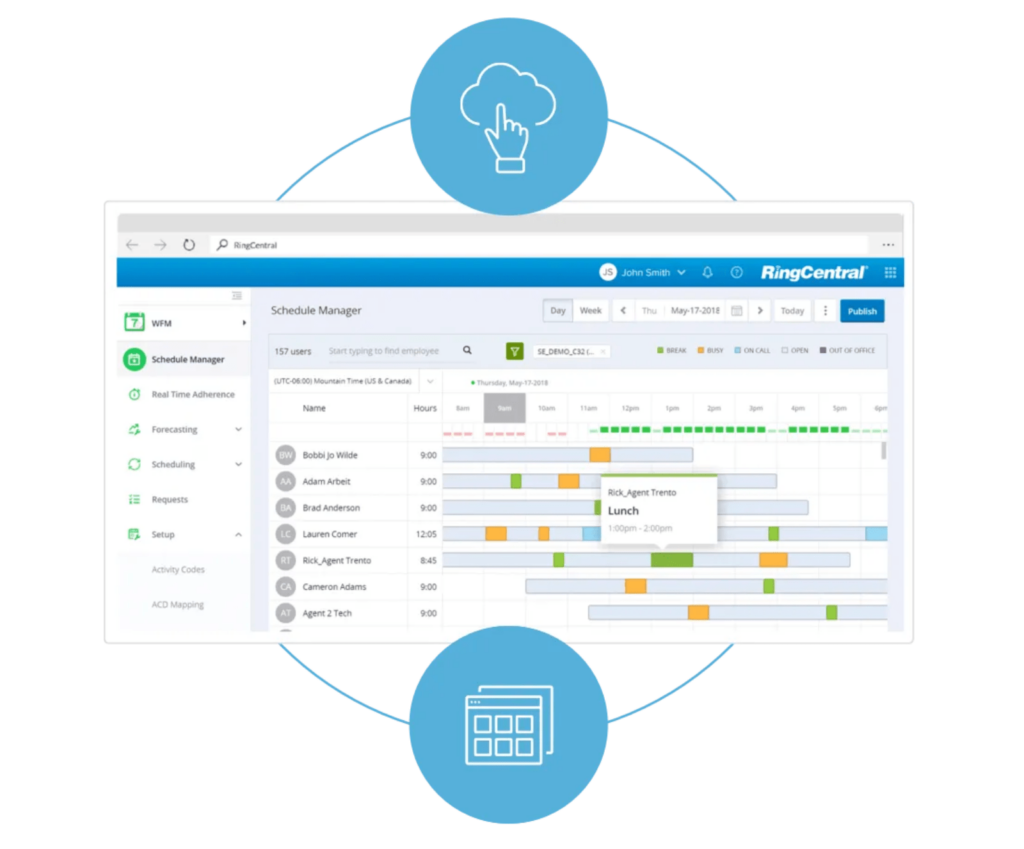

Contact center workforce optimization (WFO) is the process of making any given contact center agent’s work higher performing and more efficient. The components of contact center WFO include:
- WFM (Workforce Management): forecasting and scheduling your agents’ workload to make sure staffing levels are adequate
- QM (Quality Management): monitoring and evaluating your agents’ performance and identifying which areas they can improve on
Together, WFM and QM combine to create a solution that benefits contact centers of all sizes and specialties.
Let’s learn more about the advantages of workforce optimization for contact centers.
Efficient Employee Scheduling
WFO helps you understand how your team works, where their time is spent, and how to make sure your staffing strategy is running smoothly. When you have a solid WFO solution in place, you can forecast and schedule employees more accurately because you know your needs.
In theory, employee scheduling sounds easy. In reality, it’s a challenge. You can’t predict the exact number of customer interactions or how long each interaction will take, so your contact center may be overstaffed at some times and understaffed at others.
What you can do, however, is collect data to create an informed forecast of how much help your contact center will need at any given time.
Some WFO tools and features you can use to make this happen include:
Workforce forecasting
Workforce forecasting features can collect information on the ways that teams spend their time. This goes beyond just when agents are attending to customers—they can also collect data relating to the time employees spend in meetings, coffee breaks, training, and events.
Furthermore, this feature can also use existing data in addition to incoming information so that you can make the necessary adjustments to staffing levels in real time.
Workforce management scheduling
You may not be able to accurately predict how many customer interactions your team will have to handle at any time, but you can schedule their time and assignments correctly using workforce management scheduling.
For instance, if you find your team is overstaffed on a day when fewer calls are coming in, scheduling features can help you reassign team members to different tasks so that everyone is productive and efficient, even during downtimes.

Intraday management
Intraday management refers to monitoring staffing levels and making real-time changes in response to incoming customer interactions. This type of feature can be helpful when you’re facing unexpected spikes in demand or when your team is understaffed for unplanned reasons.
Improved Customer Experience
Brand loyalty doesn’t last forever. Sometimes, it’s just as easy to lose a loyal customer as one who hasn’t yet grown attached to your brand.
This doesn’t mean you should panic. It just means you should work to improve your customer experience. How? You should ensure your customer support team is handling inquiries and complaints appropriately.

Workforce optimization software is a great way to do this, via two routes:
Omnichannel routing
This allows customer support teams to handle requests coming via different channels such as phone, email, chat, and so on.
Usually, this feature comes with features like interactive voice response and an automatic call distributor to route incoming requests to the appropriate agent.
All these features mean that customers can get answers faster and through the communication channels they prefer. For your team, it means being able to help customers faster, increase satisfaction scores, and reduce the risk of customers leaving your brand.
Analytics
Data makes the world go round, and WFO software is built for data. It lets you collect, manage, and use information on a variety of topics, such as:
- Customer interactions, like incoming calls vs. email requests
- Average handle time per agent or department
- Individual agents’ performance stats
- Predictive analysis and forecasting for future customer interaction trends
This information can help you identify which areas need improvement, such as long handling times or frequent issues with a specific channel. You can use this data to uncover potential problems before they escalate.

Increased Employee Satisfaction
Your employee and customer satisfaction are intertwined. When your team is happy, they’re more likely to provide a better experience for customers.
A WFO solution can provide your entire team with a tool to schedule activities, tasks, and staffing. No more pulling extra hours on peak days or feeling unproductive during downtimes, which can also lead to burnout and turnover.
Some WFO software options will even add gamification and friendly competition into the mix, making the work experience more enjoyable.

Reducing Operational Costs
It doesn’t matter how large or small your business is—reducing operational costs is a goal for pretty much every enterprise out there, and WFO solutions can help with that.
Using a WFO tool means your agents will be more productive and efficient since you’ll know all about their workloads and manage their time correctly. Plus, it allows you to build a leaner team that outperforms larger ones and predict how many team members you need during peak seasons or times of the day.
Last but not least, WFOs help with compliance and scheduling adherence. Instead of manually reviewing who’s clocked in and out, taken a break, or completed enough training hours, you can generate reports showing you everything at a glance.
Low Number of Software Applications
Most WFO solutions will provide you with scheduling, forecasting, quality assurance, employee monitoring and engagement, and more. What does that mean? You won’t have to onboard and train your team to use a dozen different software applications.
In addition, you don’t have to pay for multiple subscriptions, integrations, and stand-alone pieces of software. Nor will you need to manage multiple tools at the same time.
The best WFO solutions will pull together all the features you need to help your contact center team work more efficiently, be more engaged, and keep your customers happier—and sometimes, that might even include VoIP phone service capabilities.
