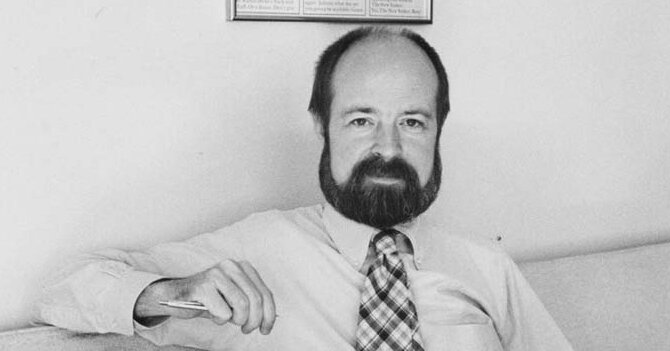

William Whitworth, who wrote revealing profiles in The New Yorker giving voice to his idiomatic subjects and polished the prose of some of the nation’s celebrated writers as its associate editor before transplanting that magazine’s painstaking standards to The Atlantic, where he was editor in chief for 20 years, died on Friday in Conway, Ark., near Little Rock. He was 87.
His daughter, Katherine Whitworth Stewart, announced the death. She said he was being treated after several falls and operations in a hospital.
As a young college graduate, Mr. Whitworth forsook a promising career as a jazz trumpeter to do a different kind of improvisation as a journalist.
He covered breaking news for The Arkansas Gazette and later for The New York Herald Tribune, where his colleagues eventually included some of the most exhilarating voices in American journalism, among them Dick Schaap, Jimmy Breslin and Tom Wolfe.
In 1966, William Shawn, The New Yorker’s decorous but dictatorial editor, wooed Mr. Whitworth to the venerated weekly. He took the job although he had already accepted one at The New York Times.
At The New Yorker, he injected wit into pensive “Talk of the Town” vignettes. He also profiled the famous and the not so famous, including the jazz greats Dizzy Gillespie and Charles Mingus (accompanied by photos from his former Herald Tribune colleague Jill Krementz) and the foreign policy adviser Eugene V. Rostow. He expanded his profile of Mr. Rostow into a 1970 book, “Naïve Questions About War and Peace.”
Mr. Whitworth offered every individual he profiled ample opportunity to be quoted, providing each with equally ample petards on which to hoist himself.
In 1966, with characteristic detachment, he wrote about Bishop Homer A. Tomlinson, an amiable Queens man who had run a small advertising agency and now, presiding over a Church of God flock, had proclaimed himself King of the World. Bishop Tomlinson claimed millions of congregants — including all Pentecostals. “He thinks they are his,” Mr. Whitworth wrote, “whether they know it or not.”
Of Joe Franklin, the durable television and radio host, Mr. Whitworth wrote in 1971 that his office, “if it were a person, it would be a bum” — but that “on the air, Joe is more cheerful and positive than Norman Vincent Peale and Lawrence Welk combined.”
From 1973 through 1980 at The New Yorker, and then at the venerable Atlantic Monthly, where he was editor until retiring in 1999, and later when he worked on books, Mr. Whitworth was most valued as a nonfiction editor.
Apart from the writers he shepherded, prodded and protected, his role was largely unheralded outside the publishing industry. To colleagues who often wondered why he abandoned reporting, he suggested that he couldn’t lick ‘em, so he joined then: He had simply become fed up with editors, newspaper editors in particular, mangling his prose which would nonetheless be published under his byline.
“You want to fail on your own terms, not in somebody else’s voice that sounds like you,” he said at the Oxford American Summit for Ambitious Writers in 2011.
Mr. Whitworth edited implacable perfectionists like the film critic Pauline Kael (who nearly came to blows with Mr. Shawn) and Robert A. Caro (who was eventually so satisfied with the final excerpts from “The Power Broker,” his biography of Robert Moses, published in The New Yorker — after Mr. Whitworth interceded with Mr. Shawn — that when The Atlantic published a condensation of the first volume of his Lyndon B. Johnson biography, he asked Mr. Whitworth to edit it).
How did he win over recalcitrant writers?

“As long as you were keeping them in the game and not doing things behind their back, slowly explaining why this would be a help to them, which it would, it was protecting them not us, and they came around,” he said at the Oxford American Summit.
For Mr. Whitworth, said the essayist Anne Fadiman, who worked with him at The American Scholar after he left The Atlantic, “editing was a conversation and also a form of teaching.”
Sometimes Mr. Whitworth offered wise counsel that went beyond editing.
After Garrison Keillor wrote an article for The New Yorker about the Grand Ole Opry, “he pushed me to do a Saturday night variety show myself, patterned on the Opry, which led to ‘A Prairie Home Companion,’ which provided me with employment for years to come,” Mr. Keillor said by email. “Unusual. Like a sportswriter becoming a major league pitcher, or an obit writer opening a mortuary. I’ve been grateful ever since.”
The New Yorker writer Hendrik Hertzberg wrote on his blog in 2011 that notwithstanding Mr. Whitworth’s capacity for self-deprecation, he and Mr. Shawn had a lot in common, “including a gentle manner, an acute understanding of writerly neuroses and a deep love of jazz.”
In 1980, Mr. Whitworth was considered the most likely candidate to succeed Mr. Shawn, who was stubbornly unwilling to be succeeded. Rather than be complicit in what he described to a friend as “parricide” in a plot to oust Mr. Shawn, he accepted the editorship of The Atlantic from its new owner, Mortimer Zuckerman. He had no regrets.
“I did get over The New Yorker, long ago.” he wrote in a letter to Corby Kummer, a former senior editor and food columnist at The Atlantic — which, he said, ”fulfilled all my expectations and hopes.”
“I couldn’t have been as happy and proud in any other job,” he added.
Under Mr. Whitworth’s editorship, The Atlantic won nine National Magazine Awards, including the 1993 citation for general excellence.
He also worked for months editing the copy for Renée C. Fox’s “In the Field: A Sociologist’s Journey” (2011) in a snail-mail exchange that went on for months without them ever meeting face to face.
Mr. Whitworth’s suggestions, Professor Fox recalled in Commentary in 2011, “were usually written in his characteristically pithy style, always courteous, gentlemanly and modest in tone, sometimes self-deprecating, and often dryly witty.”
“The editor,” she continued, “taught the author about intellectual, grammatical, aesthetic, historical and moral components of writing and editing that had been imperceptible, or unknown, to her before.”
William Alvin Whitworth was born on Feb. 13, 1937, in Hot Springs, Ark. His mother, Lois (McNabb) Whitworth, was a china and silver buyer at Cave’s Jewelers (where she often assisted Bill Clinton in buying gifts for Hillary). His father, William C. Whitworth, was an advertising executive.
He attended Central High School while working part time as a copy boy in the advertising department of The Arkansas Democrat. After graduation, he majored in English and minored in philosophy at the University of Oklahoma, but he dropped out before his senior year to play trumpet with a six-piece jazz band.
He married Carolyn Hubbard; she died in 2005. In addition to their daughter, he is survived by a half brother, F. Brooks Whitworth. A son, Matthew, died in 2022. Mr. Whitworth had lived in Conway since retiring from The Atlantic.
The literary agent Lynn Nesbit remembered Mr. Whitworth as a “stunningly brilliant and discerning editor” whose “own ego never got in the way of his editorial brilliance.” Charles McGrath, another former New Yorker editor who later edited The New York Times Book Review, said that Mr. Whitworth, unlike Mr. Shawn, “was more beloved than feared.”
But he was no pushover. While he often quoted Mr. Shawn as saying that “falling short of perfection is just an endless process,” he more or less replicated what he called The New Yorker’s “neurotic system” of meticulous editing at The Atlantic.
“He taught me that the worst approach for an editor is to put your paws all over a piece because you knew how to organize and write it better,” said Mr. Kummer, who is now executive director of Food & Society at the Aspen Institute.
”The writer’s name went on the piece, not yours,” he continued, “and no matter how fierce the arguments over phrasing, punctuation, paragraph order or word choice, the writer had to be happy with a piece or it shouldn’t run.”
When he assigned Mr. Kummer to edit an article by George F. Kennan, the distinguished diplomat and historian, Mr. Whitworth cautioned Mr. Kummer in no uncertain terms: “However much work you think it needs, remember: He is a giant.”
But when Mr. Kennan later complained that Mr. Kummer “put me through as much trouble as The New Yorker,” Mr. Whitworth replied, “That’s just what I pay him to do.”