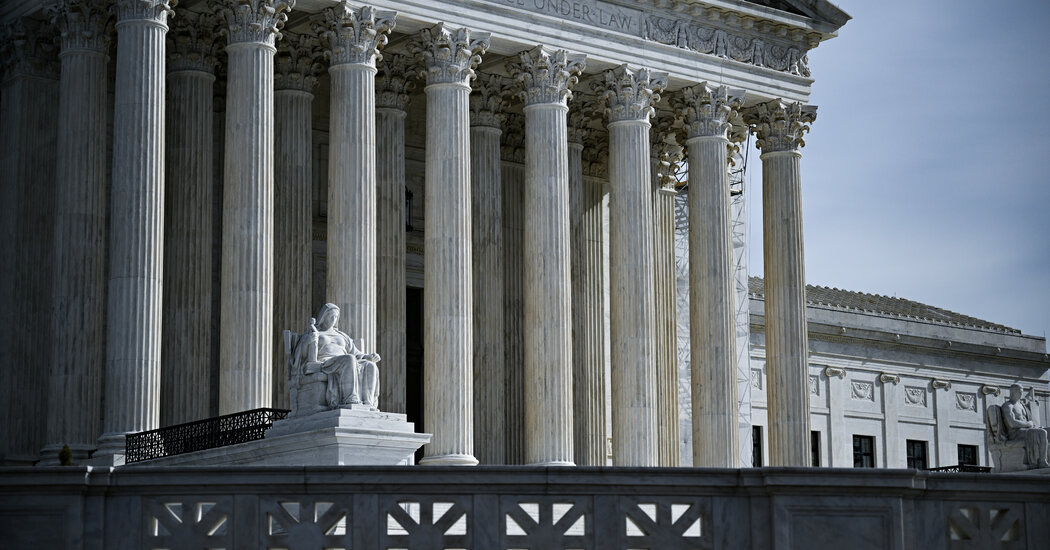

The Supreme Court ruled on Monday that states may not bar former President Donald J. Trump from running for another term, rejecting a challenge to his eligibility that threatened to upend the presidential race by taking him off ballots around the nation.
Though the justices provided different reasons, the decision was unanimous. All the opinions focused on legal issues, and none took a position on whether Mr. Trump had engaged in insurrection.
All the justices agreed that individual states may not bar candidates for the presidency under a constitutional provision, Section 3 of the 14th Amendment, that forbids insurrectionists from holding office. Four justices would have left it at that.
But a five-justice majority, in an unsigned opinion, went on to say that Congress must act to give Section 3 force.
“The Constitution makes Congress, rather than the states, responsible for enforcing Section 3 against federal officeholders and candidates,” the majority wrote, adding that detailed federal legislation was required to determine who was disqualified under the provision.
In a joint concurring opinion, the court’s three liberal members — Justices Sonia Sotomayor, Elena Kagan and Ketanji Brown Jackson — expressed frustration at what they said was the majority’s needless overreach. They said it was meant to insulate the court and Mr. Trump “from future controversy.”
“The court today needed to resolve only a single question: whether an individual state may keep a presidential candidate found to have engaged in insurrection off its ballot,” they wrote. “The majority resolves much more than the case before us.”
“Although federal enforcement of Section 3 is in no way at issue,” the opinion said, “the majority announces novel rules for how that enforcement must operate. It reaches out to decide Section 3 questions not before us, and to foreclose future efforts to disqualify a presidential candidate under that provision. In a sensitive case crying out for judicial restraint, it abandons that course.”
The first line of the concurrence appeared to be intended to needle Chief Justice John G. Roberts Jr., who was probably a principal author of the unsigned majority opinion. Quoting a line from the chief justice’s concurrence in Dobbs v. Jackson Women’s Health Organization, the 2022 decision eliminating the constitutional right to abortion, the three liberals wrote: “If it is not necessary to decide more to dispose of a case, then it is necessary not to decide more.”
They added that the majority had decided “novel constitutional questions to insulate this court and petitioner” — Mr. Trump — “from future controversy.”
“In doing so,” the three justices wrote, “the majority shuts the door on other potential means of federal enforcement.”
They gave some examples of ways in which the majority opinion undermined the force of Section 3. For instance, they wrote, the majority “forecloses judicial enforcement of that provision, such as might occur when a party is prosecuted by an insurrectionist and raises a defense on that score.” In requiring tailored legislation from Congress, the three justices wrote, the majority seemed to be “ruling out enforcement under general federal statutes requiring the government to comply with the law. “
In all, the three justices added, “the majority attempts to insulate all alleged insurrectionists from future challenges to their holding federal office.”
Justice Amy Coney Barrett, in a brief concurring opinion, agreed that the majority had gone too far, saying that it should not have addressed “the complicated question whether federal legislation is the exclusive vehicle through which Section 3 can be enforced.”

But she urged the public to focus on what was common ground among the justices.
“This is not the time to amplify disagreement with stridency,” she wrote. “The court has settled a politically charged issue in the volatile season of a presidential election. Particularly in this circumstance, writings on the court should turn the national temperature down, not up.”
“For present purposes,” Justice Barrett wrote, “our differences are far less important than our unanimity: All nine justices agree on the outcome of this case. That is the message Americans should take home.”
There was, indeed, seeming consensus on both the scope of state power and the undesirability of a patchwork of differing approaches.
“States may disqualify persons holding or attempting to hold state office,” the majority wrote. “But states have no power under the Constitution to enforce Section 3 with respect to federal offices, especially the presidency.”
The alternative, the majority said, was chaos.
“An evolving electoral map could dramatically change the behavior of voters, parties and states across the country, in different ways and at different times,” they wrote. “The disruption would be all the more acute — and could nullify the votes of millions and change the election result — if Section 3 enforcement were attempted after the nation has voted. Nothing in the Constitution requires that we endure such chaos — arriving at any time or different times, up to and perhaps beyond the inauguration.”
The decision was the court’s most important ruling concerning a presidential election since Bush v. Gore handed the presidency to George W. Bush in 2000.
In an interview on a conservative radio program, Mr. Trump said he was pleased by the ruling.
“I was very honored by a nine-to-nothing vote,” he said. “And this is for future presidents, this is not for me.”
The case arose from a challenge brought by six Colorado voters who sought to disqualify Mr. Trump from the ballot for the state’s Republican primary based on Section 3 of the 14th Amendment. The provision was adopted after the Civil War to forbid those who had taken an oath “to support the Constitution of the United States” from holding office if they then “shall have engaged in insurrection or rebellion against the same, or given aid or comfort to the enemies thereof.”
A Colorado trial judge ruled that Mr. Trump had engaged in insurrection but accepted his argument that Section 3 did not apply to the president or to the office of the presidency.
The Colorado Supreme Court affirmed the first part of the ruling — that Mr. Trump had engaged in an insurrection. Among his efforts, as detailed in the courts’ opinions: setting out to overturn the result of the 2020 presidential election; trying to alter vote counts; encouraging bogus slates of competing electors; pressuring the vice president to violate the Constitution; and calling for his supporters to march on the Capitol.
But the Colorado Supreme Court’s majority reversed the part of the trial judge’s decision that said Section 3 did not apply to the president or the presidency.
Mr. Trump asked the U.S. Supreme Court to intervene, setting out more than half a dozen arguments about why the state court had gone astray and saying his removal would override the will of the voters.
“The court should put a swift and decisive end to these ballot-disqualification efforts, which threaten to disenfranchise tens of millions of Americans and which promise to unleash chaos and bedlam if other state courts and state officials follow Colorado’s lead and exclude the likely Republican presidential nominee from their ballots,” Mr. Trump’s brief said.
His primary argument in the U.S. Supreme Court was that the president was not one of the officials covered by Section 3, which does not mention that office by name. That argument did not attract votes on Monday.
The full provision says: “No person shall be a senator or representative in Congress, or elector of president and vice president, or hold any office, civil or military, under the United States, or under any state, who, having previously taken an oath, as a member of Congress, or as an officer of the United States, or as a member of any state legislature, or as an executive or judicial officer of any state, to support the Constitution of the United States, shall have engaged in insurrection or rebellion against the same, or given aid or comfort to the enemies thereof.”
It adds, “But Congress may, by a vote of two-thirds of each House, remove such disability.”
The case, Trump v. Anderson, No. 23-719, is not the only one concerning Mr. Trump on the Supreme Court’s docket. The justices said last week that they would decide whether he was immune from prosecution for his role in the Capitol attack on Jan. 6, 2021, delaying trial proceedings in his criminal case as they consider the matter. And the justices already agreed to decide on the scope of a central charge in the federal election-interference case against Mr. Trump, with a ruling by June.
Michael Gold contributed reporting from New York.