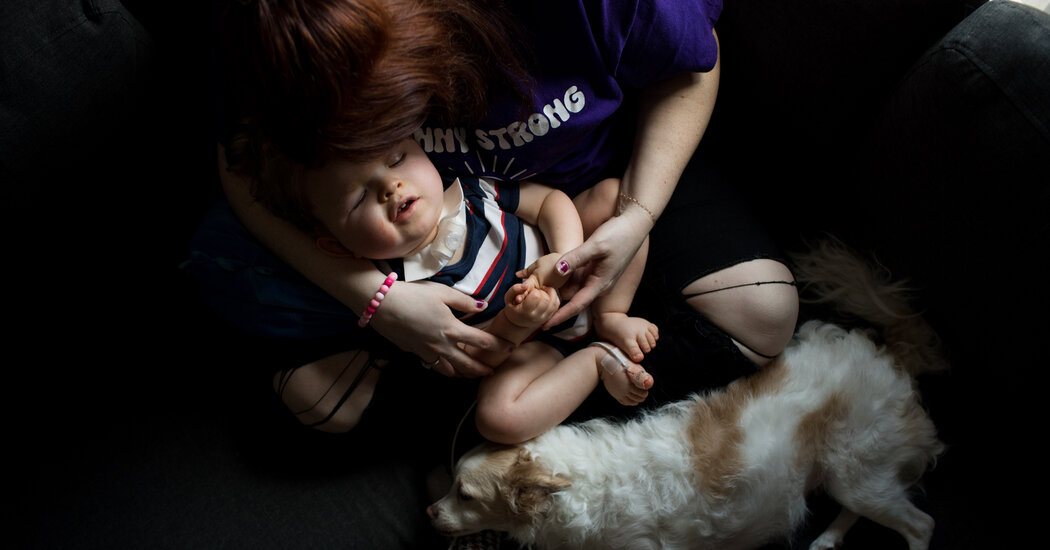

Kacey Poynter doesn’t have to commute far to clock in for work. She’s a paid caregiver and simply rolls out of bed to tend to her charge: her 2-year-old son, who sleeps in a portable playpen right beside her.
Sonny was born with a congenital malformation that impaired his brain development and needs near continuous care simply to breathe and eat. Ms. Poynter left her job at a call center when she brought him home from the hospital and has nursed him ever since rather than relying on aides or institutions. Indiana’s Medicaid program has paid her for this labor of love.
“It’s just been honestly life-changing, being able to be here with him and not worry about someone else trying to take care of him,” she said.
But her ability to keep looking after him is now in doubt. Indiana’s social services agency has announced plans to end the caregiver program, citing a nearly $1 billion shortfall in the state Medicaid budget. By July 1, parents and guardians caring for children and spouses caring for their partners would have to enroll in a different program for far less pay.
The fear, for people like Ms. Poynter, is that they will have no option but to return to work and search for home care help in the midst of a deepening national labor shortage of aides and nurses.
During the coronavirus pandemic, states received a huge infusion of federal money — money that’s now drying up, leaving Indiana, and many other states, facing tough choices about how to plug the gaping holes in their budgets.
Panicked Indiana parents who rely on the payments have held weekly rallies at the Statehouse, some toting their children. With the state legislative session ending as early as Friday, it’s unclear how the proposed cutbacks will play out.
Lawmakers point to hard budgetary math and the hazy line between above-and-beyond care that merits payment and the duties all parents owe their children.
“We have a lot of legislators who say, ‘Nobody should be depending on Medicaid to make a living,’” said Kim Dodson, chief executive officer of The Arc of Indiana, a nonprofit advocacy group. “But you have families who have made a choice to not work outside the home, to care for their loved one, because there’s nobody else who can do it and certainly can’t do it as well as them.”
Indiana’s lieutenant governor, Suzanne Crouch, a Republican who is running for governor, has called on the social services agency to postpone the cuts and demanded an outside audit of the agency’s finances. “We’re going to be judged by how we care about the most vulnerable among us,” she said in a statement.
About four million Americans with chronic illnesses or disabilities receive home and community-based services paid for by Medicaid, the government’s health insurance program for lower-income people. Most are adults, but a growing share are children with serious medical conditions who may require both skilled services and help with daily living tasks like bathing and dressing.
These services, which keep many people out of nursing homes or other institutions, may be provided by nurses or home health aides, but families have always been the backstop. In many states, relatives can be paid for providing some of that care, but Medicaid programs have typically been more restrictive about paying parents who — the thinking goes — are obligated to care for their children out of duty rather than for money.
During the pandemic, the Biden administration relaxed hurdles for parents and guardians to become paid caregivers. Congress increased federal support for Medicaid, in part so states could expand caregiving programs. According to a survey last summer by KFF, formerly known as the Kaiser Family Foundation, 37 states took advantage of the expansion to pay parents and guardians.
Kate McEvoy, executive director of the National Association of Medicaid Directors, said that the paid programs offered a way to meet family needs and to save states money that might otherwise be spent on expensive institutional care. “They want to be served in a home setting or in the community, and generally it is less costly for the Medicaid program,” she said.

Now that federal funding is shrinking, some states are downsizing programs and tightening eligibility while others are making paid caregiving permanent.
Virginia initially imposed stricter regulations for parents to become paid caregivers, but legislators are now considering a bill to lift some requirements. Ohio made its caregiving program permanent, but eligible parents or spouses must prove they cannot hire an aide, and paid hours are capped at 40 a week. Iowa and Oregon are asking the Centers for Medicare & Medicaid Services to create new paid programs.
Ms. Poynter has been paid $15 an hour for eight hours of daily personal care, plus health insurance and retirement benefits through a nursing provider, Healing Hands, which contracts with the state and oversees her work.
Sonny is a joyful child, just beginning to roll over and talk, but he is completely dependent on his parents. Each day Ms. Poynter slowly feeds him liquid meals through a tube in his stomach, suctions sputum from the breathing hole in his trachea and cleans and bandages the openings to his airway and abdomen, in addition to changing diapers and other baby routines.
On her phone, she clocks in and out for the hours she will be paid, but the distinction feels arbitrary to her because Sonny is no less dependent on her when she is off. Paradoxically, she is required to clock out before she administers medicine because Medicaid considers that skilled care and she is only contracted for personal services. “My brain is on work-mode pretty much 24/7,” she said.
Statewide, enrollment in the program and its costs skyrocketed. From March 2022 to February 2024, the number of children with disabilities or traumatic brain injuries who had paid caregivers grew sixfold to 1,629 from 262, according to Indiana’s social services agency. Fueling that growth were the costs associated with the nursing providers under contract to oversee the program. Some providers competed to recruit caregivers, advertising online and offering $1,500 or more as signing bonuses, and hundreds of dollars for referrals.
That contributed to soaring spending on caregiving for the pediatric population, to a projected $173 million this year from $2.5 million in 2021.
Melissa Keyes, executive director of Indiana Disability Rights, an independent agency, said the state had drastically underestimated the demand and failed to take steps like capping hours that some other states had imposed. “They didn’t necessarily have good guardrails in place for how that program should be managed,” she said.
The state approved nearly half of children’s caregivers for more than 60 hours per week, and a small share were approved to work around the clock.
Indiana didn’t flag the growing spending until the end of last year, when an updated forecast for Medicaid showed it was $984 million in the hole. Michele Holtkamp, an agency spokeswoman, said that the caregiving program was only one of several factors for the shortfall, “but it was the most acute.”
State Senator Ryan Mishler, a Republican who is the chairman of the Senate appropriations committee, said that in a few cases providers had billed the state more than $200,000 for the care of a single individual. “The whole point of home care is they say it’s less expensive. But when you get up to that much, it’s actually not.”
The state’s social services agency maintains that caregivers can enroll in a substitute Medicaid program that it says is just as good. But it pays less, with a maximum of about $34,000 a year. In the existing program, Ms. Poynter can make about $50,000 a year, and other caregivers approved for more than eight hours a day are paid substantially more.
State Representative Edward Clere, a Republican, blamed the agency’s limited release of details for the outcry. “It is scary for families to be told that there are going to be major changes but not have enough information to understand what those changes will mean for them,” he said.
Families in rural areas may be particularly hard-pressed to find help caring for their children. Indiana has 26 percent fewer home health aides than the national average, according to AARP.
Lydia Townsend, a service coordinator for Healing Hands who oversees more than 200 caregivers, including Ms. Poynter, said boundaries should be set to avoid any abuses of the system. But she worried that the proposed cuts would endanger families. “They’re not going to have a roof and food like what they’re able to have now,” she said.
The fallout this year from the federal government’s reduced Medicaid funding is rippling across many states at a time when their tax revenues are also falling. KFF projects that states’ expenditures on Medicaid will rise a startling 17 percent this year.
Alice Burns, associate director of KFF’s program on Medicaid and the Uninsured, asked what would be sacrificed if Indiana continued to spend so much on the caregiving program: “Wraparound services for pregnant women? Dental care for children? What are the services people will have to do without?”
Ms. Poynter isn’t sure what she will do if the cutbacks are approved, but ruled out turning to a stranger for help. She’ll probably care for Sonny until her husband gets off work and then pick up evening shifts as a waitress or a barista. Compared with friends who are sole caregivers, she said that she felt fortunate.
But nothing could make up for the time parents would have to spend away from their children, whose lives are precarious and often short.
“Tomorrow is not promised for them,” she said.