
After nearly a year with George Santos as their local congressman, voters in New York finally have their chance to choose his replacement.
Early voting has already begun in the closely watched special House election, and the Feb. 13 contest is considered a tossup with unusually high stakes — for both the immediate balance of power in the House and November’s general elections.
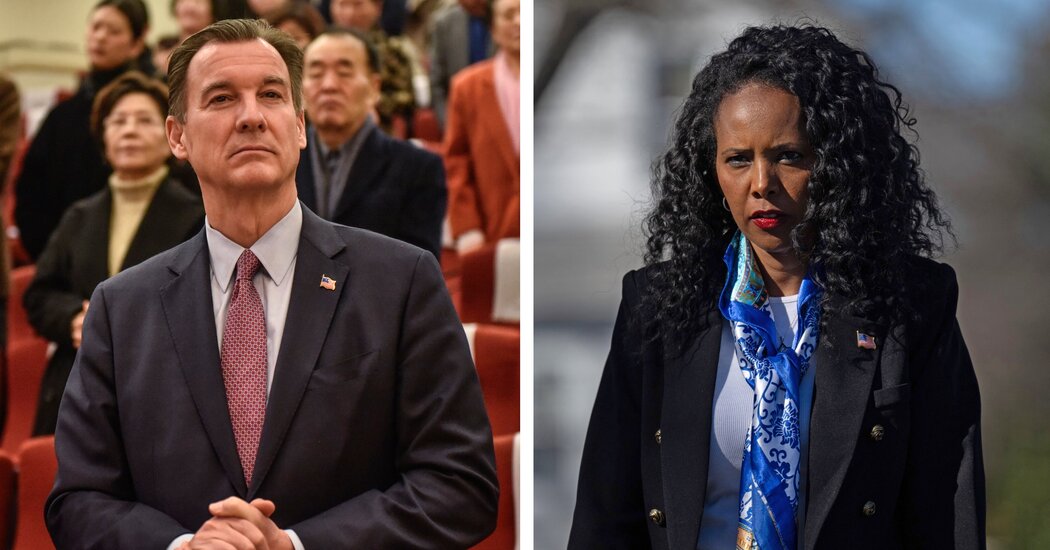
It pits Mazi Pilip, a little-known Nassau County legislator running as a Republican, against Tom Suozzi, a former Democratic congressman.
Here’s what you need to know.
How we got here
Mr. Santos, a Republican, won New York’s Third Congressional District in November 2022 amid a wave of Republican success. But it was just weeks before his résumé began to unravel based on reporting by The New York Times and other news media outlets.
His remarkable array of lies included fabricated academic degrees, a nonexistent career on Wall Street and family fortune, and even a collegiate volleyball championship. Federal prosecutors soon added 23 criminal charges accusing him of campaign fraud, credit card fraud and other crimes.
Mr. Santos survived all of it until last December, when exasperated colleagues — armed with a damning bipartisan House Ethics Committee report — voted to make him only the sixth House member expelled from the body. Gov. Kathy Hochul of New York then called for a special election to fill his seat.
Meet the candidates
Republicans nominated Ms. Pilip, who boasts a remarkable personal story but a relatively thin political résumé. She was born in Ethiopia, served in the Israel Defense Forces and became an American citizen in 2009. She won her first and only office on the part-time Nassau County Legislature in 2021, and is still a registered Democrat despite campaigning for the opposing party.
Ms. Pilip, 44, has promised to crack down on illegal immigration and address the region’s painfully high costs of living. But she has run an under-the-radar campaign, making it difficult to pin down her positions on many proposed abortion restrictions or on former President Donald J. Trump.
Mr. Suozzi, 61, is considered a political moderate. He has called for state Democrats to tighten New York’s bail laws and trumpets his time as a leader of the bipartisan House Problem Solvers Caucus. Yet he was also a reliable vote for President Biden and House Democratic leaders.
A referendum on immigration (and other issues)
The race has become a proxy fight on many of the most important issues dividing Washington, none more so than immigration. Here’s where the candidates stand on key policy questions.
Immigration: The massive influx of migrants at the southern border and in New York City has helped fuel a wave of voter discontent in the mostly suburban district. Mr. Suozzi’s answer has been a bipartisan deal struck in the Senate that would clamp down on asylum claims and close the border if there are too many attempted crossings. Though it includes a Republican wish list, Ms. Pilip slammed the deal as “the legalization of the invasion of our country.” She supports a more stringent, partisan alternative.
Abortion rights: Mr. Suozzi said he would vote to restore federal abortion rights, and has the endorsement of Planned Parenthood. Ms. Pilip said she opposes a national abortion ban. But she is personally anti-abortion and has not stated positions on other abortion constraints Republicans have advanced, like one that would bar the Pentagon from covering costs for service members who must travel for the procedure.
Israel-Hamas war: Both candidates have sought to project unflinching support for Israel amid its war with Hamas. Ms. Pilip, an Orthodox Jew, is attempting to win over Jewish Democrats alarmed by anti-Israel sentiment on the left. Mr. Suozzi has argued he would be more valuable as a bulwark against it within his party.

Presidential politics: Mr. Suozzi is a longtime ally of President Biden, but with the president’s popularity flagging, he has distanced himself.
Ms. Pilip’s position on Mr. Trump has shifted: She initially said she would not support him if he was convicted in his pending criminal trials, but recently told CNN that he was a “great president” and “didn’t commit any crime” when he tried to overturn the 2020 election. After declining for weeks to say who she voted for in 2020, Ms. Pilip told The New York Post in the race’s final days that she had supported Mr. Trump.
Santos: The infamous former congressman has been surprisingly absent from the race. Despite campaigning together in 2022, Ms. Pilip has forcefully denounced Mr. Santos. The dislike is mutual: Mr. Santos has said he will not vote this time because Ms. Pilip is not conservative enough.
What do the polls say?
Public polling has been scarce, but suggests a statistical dead heat.
A Siena College poll conducted for Newsday and released on Thursday showed Mr. Suozzi leading, 48 percent to 44 percent, among likely voters, an edge within the survey’s margin of error. The same poll showed Mr. Biden narrowly trailing Mr. Trump in a hypothetical head-to-head.
More than $16 million in outside spending has already poured into the race from super PACs, labor unions and other special interests, according to Federal Election Commission data. As of this week, Democrats have outspent Republicans roughly two to one.
But in a race that is expected to draw a low turnout, Republicans could overcome the spending disadvantage with their enviable Nassau County political machine.
Here’s what it means for the House
Republicans currently control a narrow 219-to-212 majority in the House, meaning they can afford to lose only three votes on any partisan bill. That tight margin and the party’s warring ideological factions have made the chamber almost ungovernable at times.
A Democratic pickup in New York would chip away another vote; a Republican hold could offer a small, but welcome, amount of breathing room.
The difference could have a profound impact on House Republicans’ election-year ambitions. Their ability to impeach Alejandro N. Mayorkas, the homeland security secretary, or even Mr. Biden could be made or broken by a single vote.
But it could also shape more basic functions of government in the months ahead. Beginning in March, Congress faces a series of deadlines to keep the government open and funded, and reauthorize key programs Americans rely on, like the Federal Aviation Administration and cash assistance for needy families.
Looking ahead to November
Stretching from the outskirts of Queens to the suburbs of Nassau County, the district encompasses a socially and economically diverse group of voters. That makes it an important bellwether for this fall’s general elections.
The district is among the most affluent in the country, with a median income of $130,000 a year and Gold Coast mansions that sell for tens of millions of dollars. Almost 60 percent of the district is white, but there are sizable ethnic or religious groups that could have outsize sway on the race. Roughly 20 percent of registered voters are Asian American, and almost as many are Jewish.
Mr. Biden won the Third District by eight points in 2020, and Democrats still enjoy a slight partisan enrollment advantage. But its immigrant enclaves and suburban commuters have shifted rightward in successive elections since. Both he and Mr. Trump are now deeply unpopular there.
Whoever wins, the outcome will most likely shape the playbook for candidates in a handful of coveted suburban swing districts on Long Island, in New York’s Hudson Valley and more across the country.