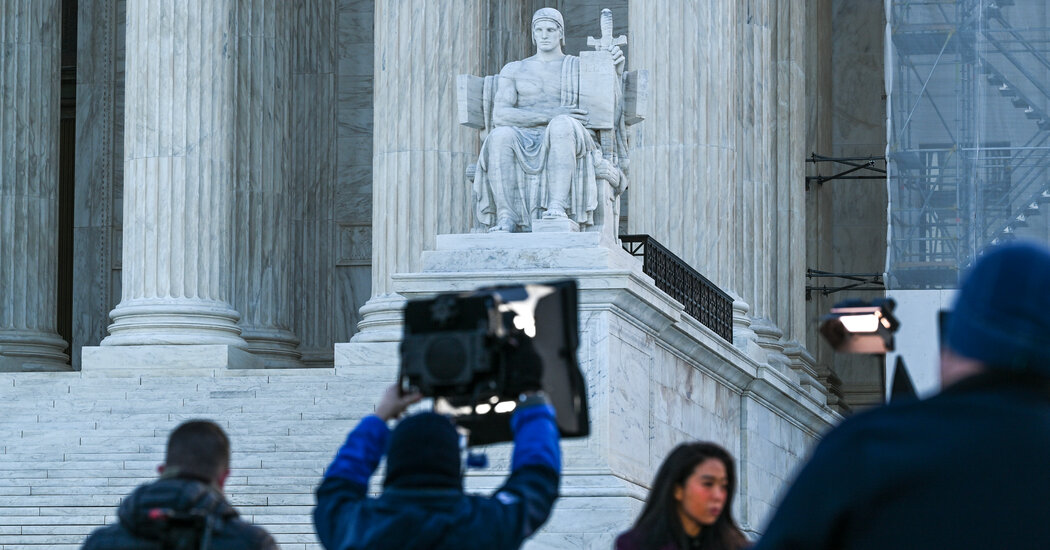

The Supreme Court on Thursday wrestled with whether former President Donald J. Trump is constitutionally ineligible to hold office again, as the Colorado Supreme Court had ruled in barring him from that state’s ballot.
The issue turns on whether Section 3 of the 14th Amendment applies to Mr. Trump because of his efforts to stay in office after losing the 2020 election that culminated in the Jan. 6, 2021, riot. The provision bars people who engaged in an insurrection against the Constitution after taking an oath to support it as an “officer of the United States.”
Here are several takeaways.
Colorado’s ruling appeared unlikely to stand.
Enough justices expressed skepticism of the Colorado Supreme Court’s decision that a majority of the court appeared likely to hand Mr. Trump a victory and vote to overturn it.
Most justices seemed generally receptive to various arguments the former president’s lawyer, Jonathan F. Mitchell, advanced in support of reversing the lower court’s ruling. His main contentions were that Section 3 is not “self-executing,” meaning it could only be enforced by a separate act of Congress, and that the provision simply did not apply to a former president like Mr. Trump.
Two of the court’s three liberal justices, Elena Kagan and Ketanji Brown Jackson, joined their conservative colleagues in displaying doubts about allowing a state to decide who can run for a national office.
Justice Kagan expressed concern that by allowing Mr. Trump to be removed from the Colorado ballot, it could set a precedent of giving individual states “extraordinary” power to affect national elections.
Justice Jackson pointed out that the text of the amendment did not explicitly include “president” in the list of offices that could face disqualification for engaging in insurrection. That was because the amendment, she argued, was not initially intended to keep Southern rebels from running for president, but rather to stop them from using their popularity in their home states to seek local offices and get back into power by running for Congress.
Some justices worried about ‘unmanageable consequences.’
Several justices asked questions that signaled concern that upholding the Colorado Supreme Court’s disqualification of Mr. Trump could unleash broader chaos or otherwise harm democracy.
Chief Justice John G. Roberts Jr. repeatedly raised the prospect that numerous other states could retaliate by removing a Democratic candidate — he did not specifically name President Biden — from their ballots by saying he, too, had engaged in an insurrection. Justice Samuel A. Alito Jr. also kept returning to that point, raising the specter of “unmanageable consequences.”
Lawyers for the Colorado voters who challenged Mr. Trump’s eligibility for the ballot and the state of Colorado urged the justices not to see that potential consequence as a reason to overturn their state’s action. Jason Murray, a lawyer for the voter group, said courts could stop an abuse of the process.
“This court can write an opinion that emphasizes how extraordinary ‘insurrection against the Constitution’ is and how rare that is because it requires an assault not just on the application of law, but on constitutionally mandated functions themselves like we saw on Jan. 6,” Mr. Murray said.
Justice Brett Kavanaugh asked Mr. Murray whether the position that Mr. Trump cannot be president again would be harmful for democracy since it would effectively disenfranchise people seeking to vote for him. Mr. Murray replied that the purpose of the constitutional safeguard is to protect democracy not just for the next cycle but for generations to come.

“The reason we’re here is that President Trump tried to disenfranchise 80 million Americans who voted against him, and the Constitution doesn’t require that he be given another chance,” he said.
Several justices wondered whether a statute is necessary.
One potential off-ramp for the Supreme Court to overturn the Colorado ruling would be to say that Section 3 is not “self-executing,” meaning that it has no legal force on its own and needs a statute enacted by Congress to be enforced.
The Supreme Court has previously deemed other parts of the 14th Amendment to be self-executing, meaning they need no such statute. But multiple justices focused on how allowing states to enforce Section 3 would be incongruous with the rest of the amendment since it largely was about taking power away from state governments after the Civil War.
Justice Clarence Thomas, the first member of the court to speak, opened the arguments by encouraging Mr. Mitchell to explain his view that the provision is not self-executing and so Colorado had no authority to enforce it.
Still, Justice Sonia Sotomayor pointed out that numerous states have relied on Section 3 to disqualify candidates for state office, even though there is no congressional statute telling states they can do that.
Some justices asked whether presidents are ‘officers of the United States.’
Justice Jackson was not the only justice who signaled interest in the argument that Section 3 does not cover people who took an oath to support the Constitution only as president — like Mr. Trump — if the phrase in Section 3 “officer of the United States” applies only to appointed officials, not elected ones.
Justice Neil M. Gorsuch noted that another part of the Constitution says that the president shall commission “all” officers of the United States and noted that presidents do not grant commissions to themselves. He also pointed out that the speaker of the House and the Senate president pro tempore are described as officers in the Constitution, but that another clause says members of Congress cannot simultaneously be “officers of the United States.”
But Justice Sotomayor was skeptical of that view, suggesting that it was a “gerrymandered” argument. Among all modern presidents, she added, it would apply only to Mr. Trump, who did not previously take an oath as a member of Congress or a military officer or a lower-ranking civilian executive branch official.
There wasn’t much talk about whether Jan. 6 was an insurrection.
Given how central the issue of engaging in insurrection was to the disqualification process, it was somewhat surprising how little the justices and lawyers talked about whether Mr. Trump’s role in the attack on the Capitol on Jan. 6 was — or was not — an act of insurrection.
Mr. Mitchell barely mentioned the storming of the Capitol during his presentation to the court, preferring to stick to highly technical issues of the law. And while Mr. Murray opened his arguments by blaming Mr. Trump for engaging in insurrection on Jan. 6, the justices largely sidestepped the factual question of whether his characterization was correct as they peppered him with questions.
Justice Kavanaugh, in a rare dip into the insurrection question, asked Mr. Murray why states should be granted the power to disqualify insurrectionists under the 14th Amendment when there was already a different “tool” to disqualify them from holding office: the federal statute making it a crime to incite, assist or engage in insurrection against the United States.
Of course, none of the more than 90 counts Mr. Trump is facing in his four separate criminal cases accuses him of taking part in an insurrection, even though the House select committee that investigated the events of Jan. 6 recommended he be charged with the federal insurrection count.
What happens next?
The justices did not indicate when they would issue a ruling. But what they decide could have consequences far beyond Colorado: There have been challenges to Mr. Trump’s eligibility in at least 35 states. Not just the outcome but also the rationale behind it will reverberate.
For example, one focus of the arguments is that if the court were to overturn the Colorado ruling on procedural grounds, rather than pronouncing on the merits whether Mr. Trump is constitutionally ineligible to be president again, it could lead to a later constitutional crisis.
Were he to then win the election, the question would return, including for members of Congress who would be asked to certify the Electoral College results on Jan. 6, 2025.