
The United States government has placed detained immigrants in solitary confinement more than 14,000 times in the last five years, and the average duration is almost twice the 15-day threshold that the United Nations has said may constitute torture, according to a new analysis of federal records by researchers at Harvard and the nonprofit group Physicians for Human Rights.
The report, based on government records from 2018 through 2023 and interviews with several dozen former detainees, noted cases of extreme physical, verbal and sexual abuse for immigrants held in solitary cells. The New York Times reviewed the original records cited in the report, spoke with the data analysts and interviewed former detainees to corroborate their stories.
Overall, Immigration and Customs Enforcement is detaining more than 38,000 people — up from about 15,000 at the start of the Biden administration in January 2021, according to an independent tracking system maintained by Syracuse University. A growing proportion of detainees are being held in private prison facilities with little means of accountability, and preliminary data from 2023 suggests a “marked increase” in the use of solitary confinement, according to the report.
A spokesman for ICE, Mike Alvarez, said in a statement that 15 entities oversee ICE detention facilities to “ensure detainees reside in safe, secure and humane environments, and under appropriate conditions of confinement.” He added that detained immigrants are able to file complaints about facilities or staff conduct via phone or through the Homeland Security inspector general.
“Placement of detainees in segregation requires careful consideration of alternatives, and administrative segregation placements for a special vulnerability should be used only as a last resort,” he said, using the agency’s terminology for solitary confinement. “Segregation is never used as a method of retaliation.”
ICE issued directives in 2013 and 2015 to limit the use of solitary confinement, saying it should be a “last resort.”
But the use of solitary confinement spiked during the pandemic in 2020 “under the guise of medical isolation,” according to Physicians for Human Rights. It dropped back in 2021 but has been increasing since the middle of that year, throughout the Biden administration, the report found. Solitary confinement placements in the third quarter of 2023 were 61 percent higher than in the third quarter of the previous year, according to ICE’s quarterly reports.
The average length of time in solitary confinement over the last five years was 27 days, almost twice the number that the U.N. believes constitutes torture. More than 680 cases of isolation lasted at least three months, the records show; 42 of them lasted more than one year.
The researchers’ work began more than six years ago when faculty members at the Harvard Immigration and Refugee Clinical Program started requesting documents from the Department of Homeland Security through the Freedom of Information Act. They eventually sued, obtaining some records through an order from a Federal District Court judge in Massachusetts.
Among the documents were copies of emails and monitoring reports exchanged between ICE headquarters officials and records of facility inspections by independent groups and the Homeland Security inspector general. The researchers also received a spreadsheet of data from the Segregation Review Management System, a database kept by ICE headquarters staff members on cases of solitary confinement across 125 facilities, including the rationale, dates, duration and location for each case.
Data analysts used Excel and Stata to calculate average durations and the total number of confinement placements, as well as to compare the data across years and facilities.
ICE arrests and holds immigrants in facilities across the country that are run by private companies. Some of those people were convicted of serious crimes in the United States and turned over to immigration authorities after they finished serving sentences; they remain in custody until they are deported. Others crossed the border unlawfully and, rather than being released into the country, are transferred to a detention center where they remain at least until the outcome of their deportation or asylum hearings.
Even in the case of convicted criminals, the use of solitary confinement is controversial. Prolonged isolation has been linked to brain damage, hallucinations, heart palpitations, poor sleep, reduced cognitive function and increased risk of self-harm and suicide.
While civil custody is not intended to be punitive, government records show the use of solitary confinement as a punishment for petty offenses or as retaliation for bringing issues to light, such as submitting complaints or participating in hunger strikes. One immigrant received 29 days of solitary confinement for “using profanity”; two received 30 days for a “consensual kiss,” according to a Homeland Security email.

‘I wanted to die’
Legal complaints and interviews with former detainees showed that humiliation was a common tactic used against those in solitary confinement. Immigrants detailed being called vulgar slurs, being strip-searched and being asked by guards to perform oral sex. One detainee said that when he had asked for water, he was told “to drink water from the toilet.” Two described being filmed and photographed while naked — one of them with feet and hands tied and with at least five officials present.
The Times interviewed several people cited in the report, who asked that their names and home countries not be identified out of fear for their safety, as they had been deported.
One former detainee, 40, from West Africa, who was kept in ICE custody for four years, including a month in solitary confinement, said that the guards had chosen predawn hours as his opportunity to leave his solitary cell, when it was too early for him to reach his lawyer or his family by phone. He said they had also kept the overhead fluorescent lights on all night, making it impossible for him to sleep.
Another, 39, a Muslim from Africa, said he had been refused Halal meals during a month in solitary confinement. He said he had been beaten, kicked in the head and kept in handcuffs even in the shower.
“It makes you crazy — you talk to the walls,” he said in an interview. “You eventually know nothing about the outside world — it’s like you’re dead.”
An asylum seeker from central Africa who spent three years in ICE custody, including a month in solitary confinement in Mississippi, said that one of the most intense methods of psychological abuse was forcing the immigrants to constantly wonder how long their isolation would last. He said a guard had told him it would last for seven days, but then another seven passed, and another. The guards laughed, he said.
“It was so stressful, I can’t even say,” he said. “I couldn’t sleep at all. I was thinking to kill myself every day — I wanted to die.”
Detainees also reported extreme gaps and delays in medical care. More than half of those interviewed by the researchers who had asked to see a doctor while in solitary confinement said they had waited one week or more to be seen, in cases including chest pain and head trauma. In one case, a detainee said he had to perform CPR on a fellow inmate “while a guard stood there in shock.”
Steven Tendo was a pastor who had endured torture in his home country of Uganda, including being placed in an underground jail cell with a python and the loss of two fingers, bit by bit, to a wire cutter.
He arrived in the United States seeking asylum, but instead of finding freedom, he was detained by ICE for 26 months, including recurring stints in solitary confinement. He was denied medication for his diabetes and his health deteriorated, but he couldn’t reach a lawyer, he said. He was placed in a full-body restraint device called “the wrap” for so long that he soiled himself.
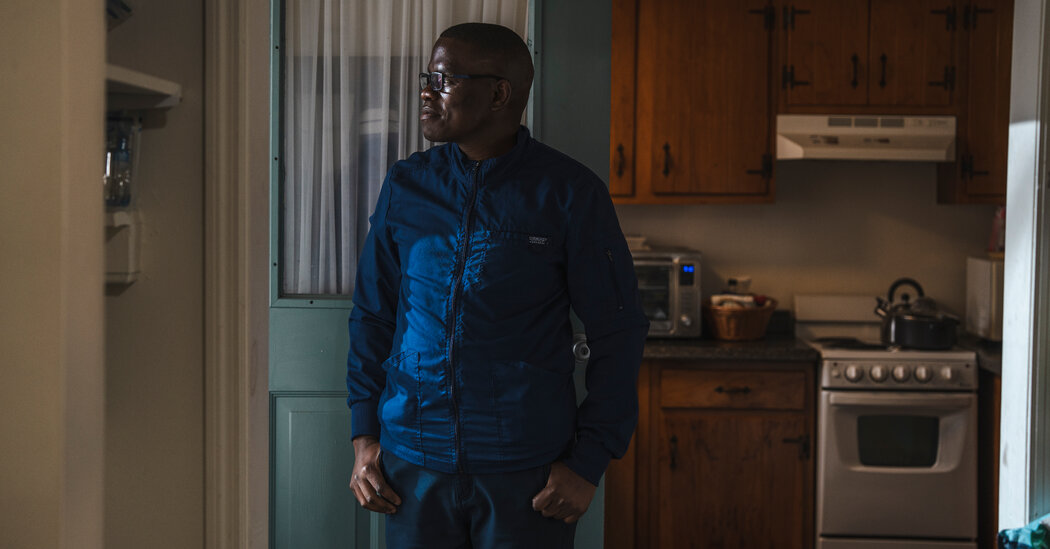
Mr. Tendo has since been released from detention and lives in Vermont, where he is still pursuing asylum.
“I would rather be tortured physically back home than go back through the psychological pain here,” Mr. Tendo said in an interview. “You wouldn’t think that a first-world country that advocates for human rights would have such venom.”
‘Severe consequences’
Records show the Homeland Security’s Office for Civil Rights and Civil Liberties and Office of General Counsel internally documented more than 60 complaints over the past four years regarding people with serious mental health conditions who were being held in solitary confinement. In some cases, their conditions were the only rationales listed: An immigrant who displayed “unusual body movements” and “irrational answers” was moved to solitary confinement for 28 days.
Nearly a quarter of the people surveyed by the researchers who had requested mental health care said they had never been seen; an additional 23 percent said they had been seen after more than a month. One person experiencing a dissociative episode was not seen for a psychological evaluation for five months, and the evaluations often lasted “maybe five minutes,” one said, done without privacy through the door of the cell.
“It’s pretty widely understood the severe consequences of putting vulnerable populations in solitary confinement,” said Sabrineh Ardalan, the director of the Harvard Immigration and Refugee Clinical Program, who contributed to the analysis. “So the lack of compliance with their own directives is really striking.”
Mr. Alvarez, the ICE spokesman, said that the agency does not isolate detainees solely for mental illness unless directed to do so by medical staff members. He added that facility leaders and medical personnel meet weekly to review cases of any individuals with mental illness who are being held in isolation.
The authors of the report recommended the establishment of a task force that would draw up a plan to end the practice of solitary confinement in ICE facilities, present it to Congress and then carry it out entirely within a year.
In the shorter term, they offered a series of other recommendations, including a formal justification for each use of confinement, more explicit standards for facilities and financial penalties for any prison contractors that did not comply.
Because there is “much less oversight within the immigration detention setting” than in the criminal setting, said Tessa Wilson, a senior program officer for the asylum program at Physicians for Human Rights, the findings are intended to “remind ICE and the general public to look and to see what’s happening.”