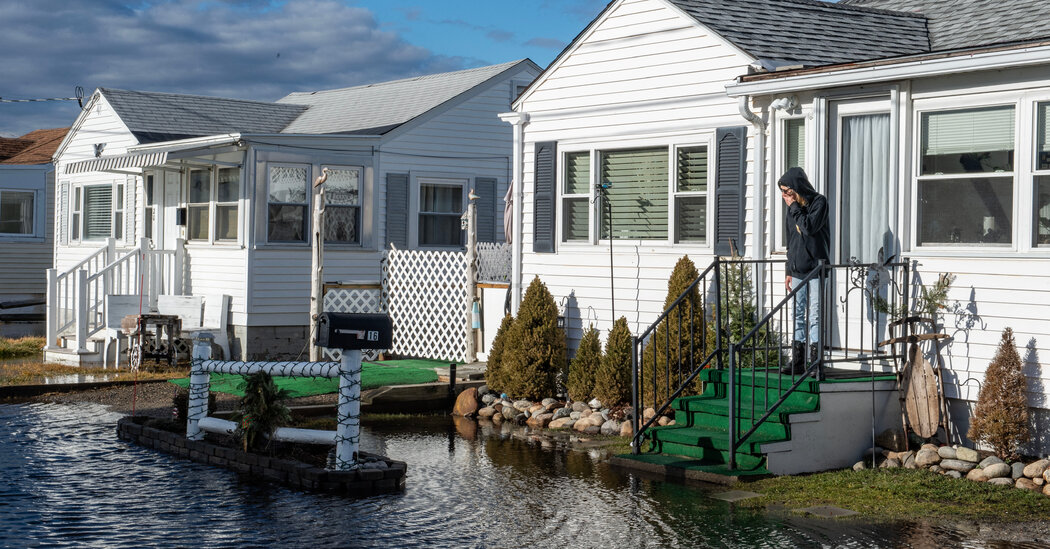

As a climate scientist documenting the multi-trillion-dollar price tag of the climate disasters shocking economies and destroying lives, I sometimes field requests from strategic consultants, financial investment analysts and reinsurers looking for climate data, analysis and computer code.
Often, they want to chat about my findings or have me draw out the implications for their businesses, like the time a risk analyst from BlackRock, the world’s largest asset manager, asked me to help with research on what the current El Niño, a cyclical climate pattern, means for financial markets.
These requests make sense: People and companies want to adapt to the climate risks they face from global warming. But these inquiries are also part of the wider commodification of climate science. Venture capitalists are injecting hundreds of millions of dollars into climate intelligence as they build out a rapidly growing business of climate analytics — the data, risk models, tailored analyses and insights people and institutions need to understand and respond to climate risks.
I point companies to our freely available data and code at the Dartmouth Climate Modeling and Impacts Group, which I run, but turn down additional requests for customized assessments. I regard climate information as a public good and fear contributing to a world in which information about the unfolding risks of droughts, floods, wildfires, extreme heat and rising seas are hidden behind paywalls. People and companies who can afford private risk assessments will rent, buy and establish homes and businesses in safer places than the billions of others who can’t, compounding disadvantage and leaving the most vulnerable among us exposed.
Despite this, global consultants, climate and agricultural technology start-ups, insurance companies and major financial firms are all racing to meet the ballooning demand for information about climate dangers and how to prepare for them. While a lot of this information is public, it is often voluminous, technical and not particularly useful for people trying to evaluate their personal exposure. Private risk assessments fill that gap — but at a premium. The climate risk analytics market is expected to grow to more than $4 billion globally by 2027.
I don’t mean to suggest that the private sector should not be involved in furnishing climate information. That’s not realistic. But I worry that an overreliance on the private sector to provide climate adaptation information will hollow out publicly provided climate risk science, and that means we all will pay: the well-off with money, the poor with lives.
The problem that privatization presents was captured in a 2018 CNBC interview with Joel Myers, the founder of AccuWeather, which provides both public weather forecasts and more detailed and customized forecasts to paying customers. He related this story about one of AccuWeather’s clients, the railroad company Union Pacific:
We told them a tornado was heading to a spot. Two trains stopped two miles apart. They watched the tornado go between them. Unfortunately, it went into a town that didn’t have our service and a couple of dozen people were killed. But the railroad did not lose anything by that pinpoint forecast.
Dr. Myers went on to note that AccuWeather does provide advertiser-supported weather information to the public. But his description is distressing to consider as climate disasters exact heavier human tolls.
Global warming is a collective tragedy, and so its solutions, especially around information for adapting to the risks it portends, must be a public good. That is why governments must step up. People have a fundamental right to science. The climate science community needs to rapidly develop a publicly available alternative to paywalled climate information; failing to do so would be unjust and dangerous.
The privatization of climate information is already upending my professional community, as scientists leave academia and national labs for high-paying start-up and consulting jobs. It’s a sensible move; academic institutions and national labs are slow moving and incentivize cautious, conservative science, which is antithetical to the urgency many of us feel in the face of accelerating climate impacts. But we risk losing a generation of solutions-oriented scientists to the private sector at the exact moment the public sector must grow those skills.
Particularly worrying to me as a scientist is that science from private firms lacks the scrutiny that public science undergoes. Companies as a result may be incentivized to over-claim their accuracy or bury inconvenient findings with potential liability implications. That’s not to say that privately generated information may not be valuable or superior to what governments offer to the public. Federal flood-risk assessments, for example, understate the risk of flooding for many homeowners. But the answer is not to cede the science undergirding the valuation of housing markets to an inscrutable private flood-risk model of unknown reliability. The answer is better publicly available information.
Climate risk information, especially information that helps communities manage impacts like floods and wildfires, should be as available as government weather forecasts. Governments should provide the resources so that this information can be obtained, assessed and acted upon by the public. Doing so is essential to our health, safety and collective well-being.
Making this information a public good, available to all members of society for their benefit, would require a constellation of public efforts alongside the private ones.

Internationally, the nearly 200 countries that adopted the United Nations Paris climate agreement in 2015 committed, as the U.N. pointed out, to “strengthening the global response to climate change by increasing the ability of all to adapt and build resilience, and reduce vulnerability.” Such a commitment implies that the information needed to adapt is a fundamental right for humanity. Given the year-on-year acceleration of climate privatization, countries should make a point of reaffirming that right and sharing ways to protect it each year.
At the federal level, it would require establishing a national adaptation plan, revisited annually, to ensure communities around the United States have equal access to the tailored risk assessments they need to make long-term adaptation investments, such as creating flood setbacks and burying power lines. At a minimum, it means that individuals could log into a website and quickly access a clear climate risk assessment for where they live based on validated, transparent and reproducible science without entering their credit card information to pay for it. Getting there will require greater federal investments in applied climate risk science, while ensuring that any publicly funded research is held to stringent standards of openness.
Lastly, universities with climate expertise should establish climate adaptation clinics to engage directly with their communities. These clinics would develop and make available customized information on local climate threats and how to best manage them, building trusted connections with the community in the process. This effort could be modeled after agricultural extension programs at land-grant universities that support local communities in areas such as agriculture, business development and health. It would have the added benefit of keeping scientists who want to be solutions-focused in academia and national labs.
As the private sector accelerates efforts to commodify climate information at the exact moment humanity most needs it, governments at all levels must expand efforts to make climate risk assessments and adaptation strategies widely available and understandable. Freely shared information will save lives.