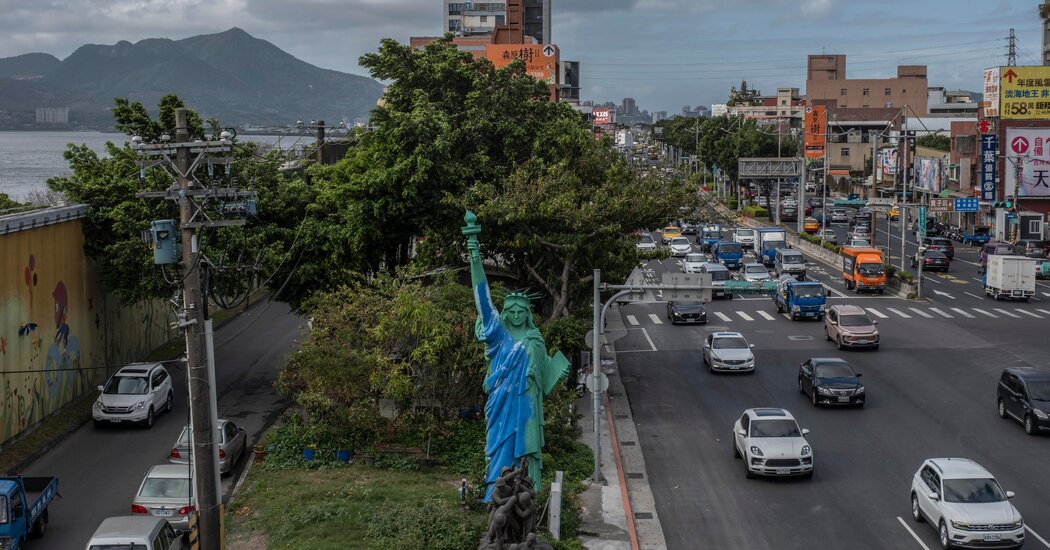

The collection of American memorabilia, vast and well-lit in a busy area of City Hall in the southern Taiwanese city of Tainan, reflected decades of eager courtship. Maps highlighted sister cities in Ohio and Arizona.
There was a celebration of baseball, an American flag laid out on a table. And in the middle of it all, a card sent to the United States that seemed to reveal the thinking of Tainan, a metropolis of 1.8 million, and nearly all of Taiwan.
“Together, stronger,” it said. “Solidarity conquers all.”
The message was aspirational — a graphic illustration of profound insecurity. Taiwan is a democratic not-quite nation of 23 million, threatened by a covetous China, with a future dependent on how the United States responds to the ultimate request: to fight the world’s other superpower if it attacks and endangers the island’s self-rule.
Now more than ever, the fraught psychology of that predicament is showing signs of wear. With China asserting its claim to the island with greater force, and the United States increasingly divided over how active it should be in global affairs, Taiwan is a bundle of contradictions and doubts, less about its own government’s plans or even Beijing’s than the intentions of Washington.
Vice President Lai Ching-te of the Democratic Progressive Party won Taiwan’s presidential election this month in part because he looked like the candidate most likely to keep America close.
Pre-election polling showed that most people in Taiwan want stronger relations despite the risk of provoking China. They support the recent rise in weapons sales from the United States. They believe President Biden is committed to defending the island — but they worry it is not enough.
As they watch Washington deadlock on military aid for Ukraine and Israel, and try to imagine what the United States would actually do for Taiwan in a crisis, faith in America is plummeting. The same Taiwanese poll showing support for the U.S. approach found that only 34 percent of respondents saw the United States as a trustworthy country, down from 45 percent in 2021.
Recent studies of online discussion show a similar trend: deepening concerns that the world’s oldest democracy will lack the strength or interest to really help. In interviews, voters described feeling like passengers. Many see the United States as an unpredictable driver that could get them to safety but could just as well abandon the wheel.
And on a small island about 100 miles from China that has a defense budget only a fraction of Beijing’s, those doubts about America can have their own dangerous impact.
Taiwanese and American analysts are unsure what a widespread lack of faith in the United States could inspire — for some, perhaps a commitment to do more with self-defense. But for others, it contributes to a lack of urgency. If survival depends on the Americans, and who knows if they will ever come, the argument goes, what is the point?
The risk for Taiwan — and those who see it as a first line of defense that, if lost to Beijing, would give China greater power to dominate Asia — is that distrust toward the United States could make it easier for the island to be swallowed up.
“It’s really important that they believe the United States is coming to intervene on their behalf because there are a lot of studies showing that can influence how well they hold out,” said Oriana Skylar Mastro, a fellow in international studies at Stanford University and the American Enterprise Institute. “And we’d need them to hold on long enough for us to get there.”
An Abandonment Complex
The origins of Taiwan’s distrust can be glimpsed in a row of mildewing houses in the mountains above the skyscrapers of Taipei, the island’s vibrant capital. Starting around 1950, American soldiers occupied these bungalows, with their speckled floors and large yards.

The troops’ presence seemed permanent. There were about 9,000 American soldiers in Taiwan in 1971 when a treaty ensured that the United States would defend Taiwan against any attacker. Then, rapidly, they were gone.
The U.S. restoration of ties with Beijing in 1979, after President Richard M. Nixon’s visit to Beijing in 1972, spurred the departure of American promises and personnel. Neighbors recalled friends disappearing with toys, and kitchen utensils left behind to rust.
Eva Wang worked as a legal adviser for the American military in the 1960s. She said she cried the day in 1979 when U.S. officials lowered the American flag for the last time, learning a powerful lesson: “Our destiny was out of our control.”
Her husband, Wayne Chen, a retired prosecutor, concluded — as did many others — that the Americans could not be trusted.
“If a war really breaks out and the C.C.P. comes over,” he said, referring to the Chinese Communist Party, “then of course the U.S. military will not defend us.”
Researchers in Taiwan have found that 1979 continues to shape Taiwanese views. Even for those not alive at the time, the American reversal stings, like a parent’s adulterous affair, endlessly discussed.
“If you look at the skepticism generated from within Taiwan today, it’s mainly about the U.S. abandoning Taiwan,” said Jasmine Lee, the editor of US-Taiwan Watch, a think tank that recently contributed to a report on doubts about the United States. “It’s reasonable because we’ve been abandoned before.”
Nixonian history is still baked into relations. The United States has maintained a policy of “strategic ambiguity” since 1979, declining to commit outright to defending Taiwan, which China sees as lost territory. That means everything the United States does is closely watched through a lens of past and potential betrayal.
The disastrous American withdrawal from Afghanistan in 2021; Russia’s invasion of Ukraine and Washington’s decision not to send troops; the 2022 visit to Taiwan by Nancy Pelosi, which led to a strong Chinese military response — news events have had a sharp effect on Taiwanese public opinion about the United States, according to polls and discussion in Chinese-language media outlets and online platforms.
Dr. Mastro, of Stanford, said that in some cases, “Taiwan’s views of trustworthiness make no sense.” While polls in Taiwan showed doubts rising because America did not do more to help Ukraine, she said, the reality was that the United States held back in part “so we could be prepared to defend Taiwan.”
But abandonment has not been the only worry. Data scientists with a Taiwanese think tank identified 84 separate narratives of skepticism toward the United States in online discourse from 2021 to 2023. Some people argued that the United States was too weak to defend distant Taiwan, or that it was a destructive force, a creator of chaos. Others declared America to be anti-democratic and a “fake friend.”
Chinese commenters often tried to amplify the criticisms, and the “fake friend” line came from the mainland, researchers said, but nearly everything else grew out of Taiwanese anxiety.
Hsin-Hsin Pan, an associate sociology professor at Soochow University in Taipei who studies Taiwanese public opinion, said insecurity and frustration with a lack of influence over its own fate had become an even bigger part of Taiwan’s identity.
Taiwan is at a lopsided crossroad of U.S.-China relations. It sits in the shadow of an increasingly authoritarian giant that sees Taiwan as a haughty, breakaway appendage that must be returned, by force if necessary. And it is thousands of miles from the United States, where polls since 2021 have shown that a plurality of Americans oppose committing troops to Taiwan’s defense. In one recent poll, 53 percent of Republicans said the United States should stay out of global affairs.
“There is no anti-Americanism here,” Dr. Pan said. “But there is substantial skepticism.”
Seeking Steadiness
Some of Taiwan’s most vocal U.S. skeptics have learned from not just history, but also personal experience. They were graduate students in New York during the Covid-19 pandemic, disillusioned by the chaotic response and anti-Asian prejudice. Others are engineers with Silicon Valley connections who worry that Taiwan’s microchip industry, which makes 90 percent of the world’s most advanced semiconductors, will be weakened by pressure to manufacture in the United States — stealing the jewel that makes the world want to keep the island out of Chinese hands.
They are also immigrants like Amy Chou, 67, a no-nonsense restaurant owner in San Francisco who returned to Taiwan this month to vote. Like many others, she said she thought the United States would help Taiwan in a war, but she was not sure and did not trust America to think about anything but its own economic interests.
“Americans just want us to buy more weapons,” she said at a political rally in Tainan. “They want our money, and want our chips. ”
“If Trump wins,” she added, fearing the effect of another four years with an “America First” foreign policy, “it’ll be worse.”
Taiwanese politicians are hesitant to discuss such concerns — including Mr. Lai, a former mayor of Tainan, the city with the pro-America shrine. But in a sign of his priorities, he addressed the international media before thanking supporters after securing victory last Saturday night. For a leader reviled by Beijing for having once called himself a “pragmatic worker for Taiwanese independence,” that seemed to suggest he believed nothing mattered more for Taiwan than outside support.
Not that he or other officials are solely lobbying for help. Taiwan’s 2024 budget included a jump in military spending to 2.5 percent of gross domestic product, or $19 billion. But its leaders have been slow to shift toward the drones, missiles and other asymmetrical weapons that, according to analysts, would be needed to hold off a Chinese amphibious invasion.
There is even less urgency in Taiwanese society. Volunteer enlistments in the Taiwanese military have been declining since 2021. Deferments from compulsory service are common, and civil defense training at the community level, while improving, remains infrequent.
American officials and analysts often lament the inaction. They have shown less interest in doubts about the United States. Laura Rosenberger, chairwoman of the American Institute in Taiwan, the U.S. embassy in all but name, simply praised Taiwan’s “robust democracy” when asked at a news conference about the rising skepticism.
But instead of flattery, many on the island long for a candid reckoning about the past, America’s struggles in the present, and a shift from strategic ambiguity to strategic clarity. Put U.S. troops or equipment in Taiwan, some argue; swap intelligence, make and publicize shared plans — commit long-term to protect an island that may be both a pawn and where the U.S.-led global order wins or loses.
“There needs to be a commitment to elaborate on why Taiwan matters to America’s national interests,” Dr. Pan said.
She added: “We need to know there’s a steadiness to power.”
John Liu and Christopher Buckley contributed reporting from Taipei, Taiwan.